
While we are just one-to-three trading days removed from all-time highs on the major market averages, Friday’s equity-market retreat provided a stark reminder that while the long-term trend in stocks has been up, the sailing is seldom smooth, with a log-scale chart of the S&P 500 over the past century illustrating that there have been plenty of squalls along the way.
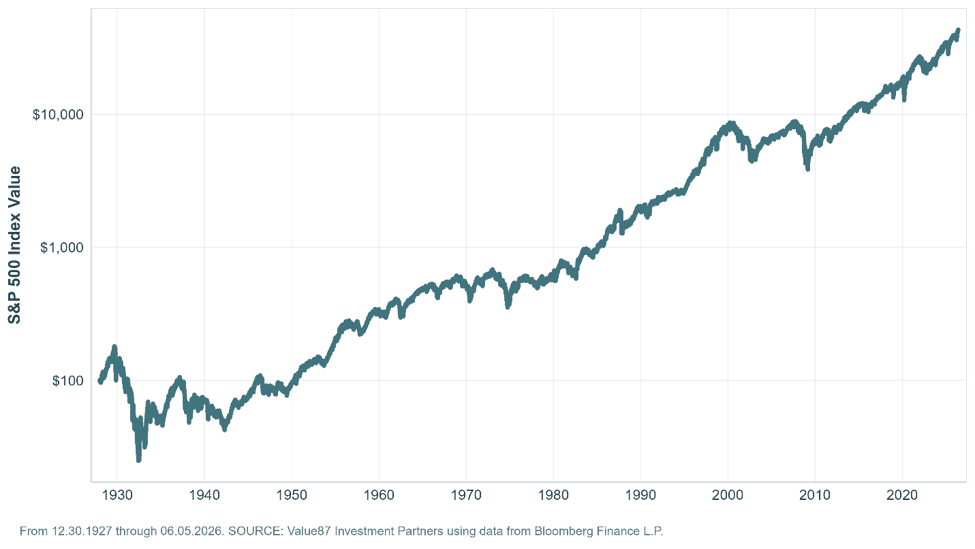
Indeed, relatively modest downturns like what we saw on Friday, 5% pullbacks, 10% corrections and even 20% Bear Markets are not infrequent happenings, with sizable selloffs occurring each and every year.
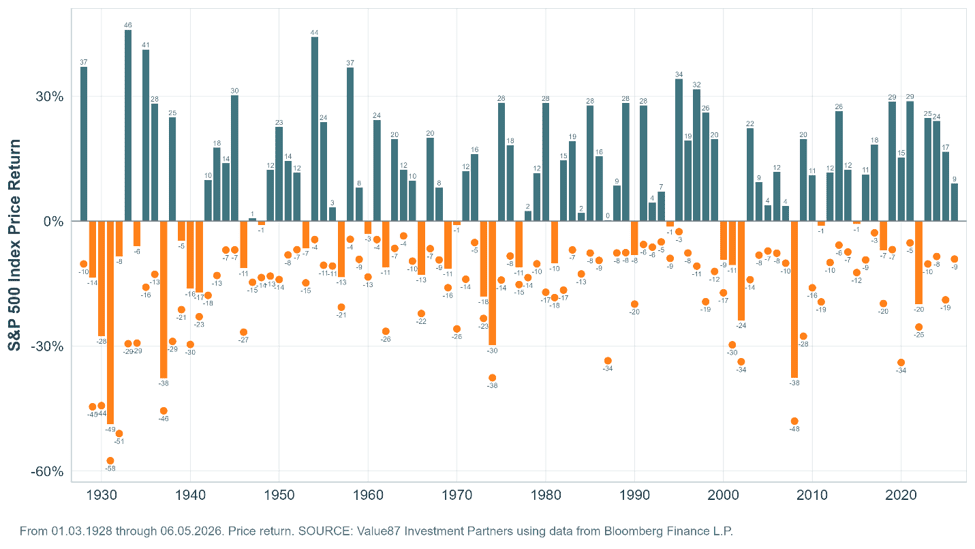
The red ink was far more colorful for anything AI-related on Friday, but the magnitude of the 2.64% drop in the popular S&P 500 index ranked No. 481 on the list of one-day setbacks dating back to 1928. Markets have been far more volatile in certain years in the past, but simple math suggests that a daily retreat of even greater scale has occurred approximately four times per year on average, based on Value87's analysis of historical S&P 500 data, although future market behavior may differ. We note that five such events took place in 2025, even as the S&P ended that volatile year up more than 17%.
Given that the major market averages essentially moved straight up since the last week of March, we can’t argue that some profit-taking was not overdue, especially following the meteoric advances in many AI-Infrastructure names. Interestingly, as the table below shows, several A.I. superstars, like chipmaker Intel (INTC), optical components provider Lumentum (LITE) and memory producer Micron Tech (MU), are now in Bear Markets, having fallen 20% from their recent highs, despite still enjoying extraordinary triple-digit gains from their 52-week lows.
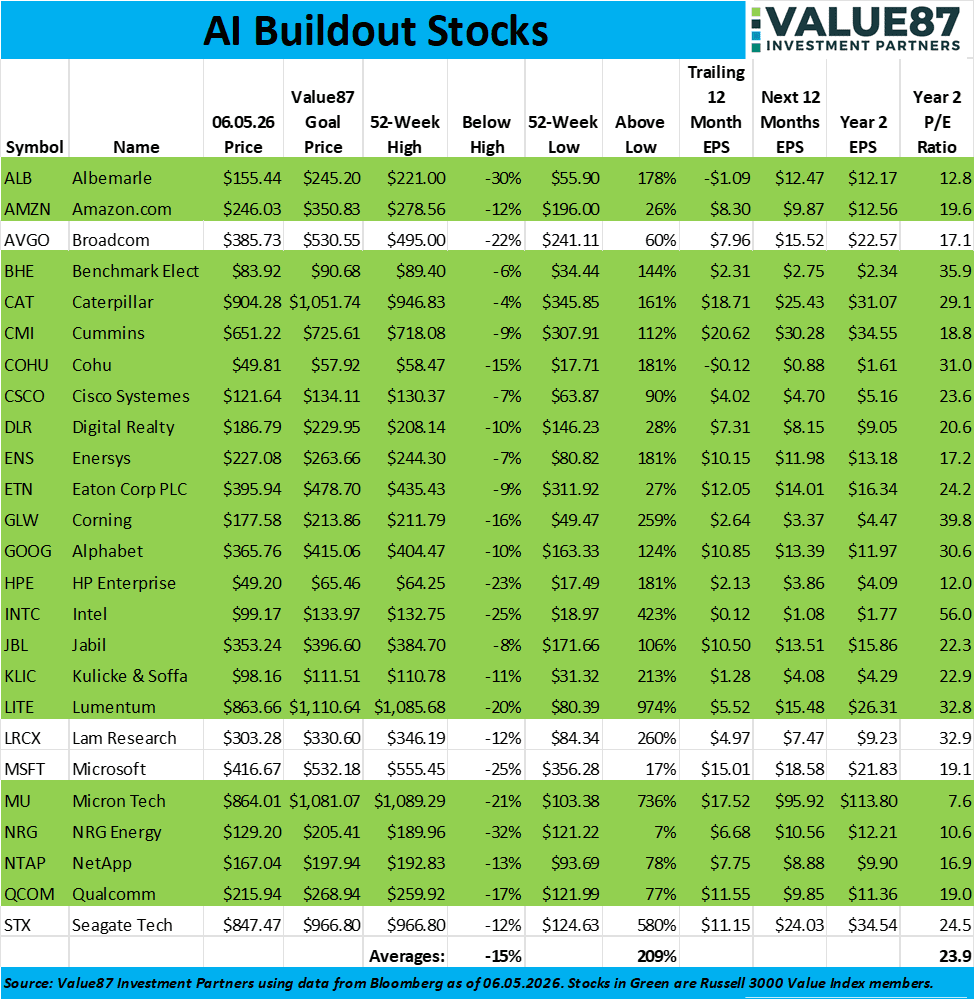
While we continue to like our long-held strategy of trimming big winners along the way, and we have taken money off the table on most of the stocks outlined above, we note that the last column of the table – The Year 2 P/E ratio – suggests to us that valuations on the whole for our AI holdings are not overly rich, so we believe that the AI rally has some solid underpinnings. And, believe it or not, 21 of the 25 stocks are members of the Russell 3000 Value index!
We also think it valuable to dive into two of the catalysts for the AI-carnage last week, a big stock offering from Alphabet (GOOG) and disappointing forward guidance from Broadcom (AVGO).
Shares of Alphabet bounced back a bit later in the week after an initial selloff Tuesday following news that the internet media and services titan would raise $80 billion through an equity sale (the amount was subsequently upsized to $84.75 billion). The capital raise includes a $40 billion at-the-market share issuance program, a $10 billion investment from Berkshire Hathaway and approximately $34.75 billion of additional public offerings that were reportedly multiple times oversubscribed. While the sheer size of the raise seemingly surprised the market, the strong demand suggests that many folks remain confident in Alphabet's long-term prospects.
Management has indicated that roughly $30 billion of the proceeds will be used to satisfy tax obligations tied to employee equity awards, with the remainder funding an aggressive expansion of AI infrastructure, global compute capacity and next-generation TPU chips. Alphabet is targeting a mammoth capital spend of $175 billion to $185 billion in 2026 as it seeks to support growing demand from Google Cloud, Gemini and large AI customers such as Anthropic, while positioning itself to capture additional enterprise AI opportunities.
Despite the demand for the offering, skeptics view the move as evidence that the AI arms race has become increasingly capital intensive and worry that free cash flow could remain constrained as investment spending ramps. Supporters, however, see the raise as a strategic move that strengthens Alphabet's ability to capitalize on what may be a once-in-a-generation technology transition, pointing to surging cloud demand, expanding AI backlog and the endorsement implied by Berkshire Hathaway's participation. Of course, we note that this is just the second sizeable transaction without Warren Buffett at the day-to-day helm, so the jury is still out on the Oracle of Omaha’s successor Greg Abel.
Our enthusiasm for Alphabet has not waned, and we continue to see GOOG shares as an attractive opportunity based on our valuation methodology to own a dominant global franchise with leadership positions in search, digital advertising, cloud computing and artificial intelligence. We think the near-term concerns surrounding dilution (which is on the order of 2%, given the massive market capitalization of the company) and elevated capital spending are a bit overdone, and we note that the company continues to generate enormous operating cash flow and possesses competitive advantages that few businesses can match. For patient investors, today's investments in AI infrastructure could help solidify Alphabet's growth prospects for years to come. Our V87 Goal Price for GOOG shares is $415.
Despite reporting record revenue, operating profit and free cash flow in fiscal Q2, driven by accelerating growth in AI revenue, shares of semiconductor giant Broadcom ended the week more than 13% lower after hitting an all-time high on Wednesday. Revenue of $22.19 billion (+48% YoY) came in slightly above the consensus analyst estimate reported by Bloomberg of $22.13 billion, while adjusted EPS of $2.44 beat the $2.40 average forecast. AI semiconductor revenue surged 143% YoY to $10.8 billion driven by demand for custom AI accelerators and AI networking. The Semiconductor Solutions segment hit a record $15.0 billion (+79% YoY), while Infrastructure Software contributed $7.18 billion (+9% YoY). Free cash flow reached a record $10.3 billion (+60% YoY).
We thought the outlook was solid, but it evidently fell short of lofty expectations. The revenue forecast for Q3 of $29.4 billion (+84% YoY) beat the Wall Street consensus of $28.6 billion, but the more closely watched AI semiconductor revenue guidance of $16 billion came in below expectations of $17.2 billion. The gross margin guidance was also trimmed to 74% due to a higher mix of lower-margin semiconductor revenue. There was reporting that a key structural factor behind the “softer” AI revenue outlook was Broadcom's shift away from selling full rack solutions to Anthropic, moving instead to chip-only sales. Management, led by Hock Tan, reaffirmed its full-year FY2026 AI chip revenue target of $56 billion and maintained its longer-term view that AI chip revenue should exceed $100 billion in fiscal year 2027, with Mr. Tan also signaling a pivot away from M&A in favor of organic AI growth.
Incredibly, AVGO now trades for just 17 times estimated Year 2 EPS, while we have long been fans of Mr. Tan and his leadership team, not to mention Broadcom’s high-quality diversified product line with leading positions in semiconductor chips that power data centers, networking, broadband, wireless communications and artificial intelligence workloads. The company's past acquisition of VMware has expanded its portfolio into mission-critical infrastructure software, creating a powerful combination of recurring software revenue and high-margin semiconductor businesses. While AI enthusiasm has driven strong share-price performance, Broadcom's robust cash flow generation, disciplined capital allocation and history of willingness to grow its dividend continue to support long-term value creation for investors. We think AVGO offers exposure to several of the most important technology trends while benefiting from a business model built on scale, customer relationships and recurring revenue streams. Our Value87 Goal Price is now $531.
We spend a lot of time on these missives discussing AI, given its significant impact on our portfolios and our many decisions this year and last to selectively trim positions to keep our overall exposure within our comfort zone. After all, we never forget that investors are notoriously fickle…on both the upside and the downside.
Such was what we saw with the trading action last week in Hewlett Packard Enterprise (HPE) as the wisdom of the market alternately decided that the business was worth $57 million at the end of the prior week and more than $80 billion on Tuesday morning and $65 billion on Friday. Despite giving up more than half of the Tuesday advance, shares of the IT hardware and storage concern ended the week up more than 14% after the company delivered a massive fiscal Q2 beat across the board. Revenue came in at $10.68 billion (+40% YoY), almost 10% ahead of the consensus estimate of $9.74 billion. Adjusted EPS for the quarter of $0.79 crushed the $0.54 estimate by 46%. The period marked record revenue and gross margins, as well as HPE's highest-ever second quarter of free cash flow generation. The outperformance was driven by surging AI-fueled demand for servers and networking infrastructure, with the Networking segment posting 31% data center revenue growth.
Management raised full-year adjusted EPS guidance to $3.35–$3.45, up sharply from the prior range of $2.30–$2.50 and well above the $2.43 consensus analyst estimate. HPE also said it was raising its full-year revenue growth outlook to +29% to +33%, up from +17% to +22%, with projections for revenue growth for the Networking segment to spike between 72% and 75%. The company also introduced a fiscal year 2027 framework projecting revenue growth of 8% to 12% and adjusted EPS growth of 12% to 16%, with free cash flow of at least $4.5 billion. CEO Antonio Neri characterized the guidance raise as a "volume story," not a pricing one, underscoring the depth of underlying AI-compute demand.
While it feels a bit crazy to write, despite being up more than 100% thus far in 2026, shares of HPE are trading for just 12 times the Year 2 EPS forecast. True, the stock often has traded at a discount to the broader market despite solid cash flow generation and a growing mix of recurring revenue, but we believe the company is well-positioned to benefit from long-term demand for artificial intelligence, hybrid cloud computing, networking and data center modernization. We think HPE's strong enterprise relationships, expanding software and services offerings, and shareholder-friendly capital allocation provide a foundation for steady value creation. HPE offers an attractive combination of an attractive forward valuation, increasing dividend-income potential and possible multiple expansion if management successfully capitalizes on the accelerating need for AI and digital infrastructure. Our V87 Goal Price has been hiked to $64.
The financial press and market pundits were quick to blame Friday’s pullback on the upcoming launch of SpaceX as folks took profits and raised cash in the hottest areas of the market ahead of the much-anticipated IPO. While we respect that there is virtually unprecedented euphoria for Elon Musk’s latest offering, IPOs are not part of our playbook as there is seldom any sense in going public at a bargain price and there often is opportunity to buy these stocks down the road when the underlying businesses are not generating red ink. SpaceX lost $4.9 billion last year.
We are reminded of the Facebook IPO back in 2012, when the stock was offered at $38 only to trade in the $26 range three weeks later. Obviously, Facebook, now known as Meta Platforms (META), has been a stellar long-term performer…and we have owned the social media behemoth for a number of years, but many who take part in IPOs are in them only for a quick buck.
Yes, we realize that there can appear to be greener grass in these sexier areas of the market, but we have long believed that paying attention to valuation metrics is critical to our investment process. We sleep better at night knowing that our portfolios, despite their significant AI-related exposure, continue to boast multiples that are on the less expensive end of the spectrum with dividend yields that are more generous than those of the broad-market indexes.
We concede that the metric gap for our portfolios is not as great as it was seven months ago, but that is a byproduct of outperformance of Value-oriented strategies. One week does not a trend make, but the Russell 3000 Value (R3KV) index outperformed its Russell 3000 Growth (R3KG) counterpart by more than 330 basis points last week. And since last Halloween, the performance derby is heavily skewed in favor of Value, with the total return (which includes dividends and their reinvestment) for the R3KV standing at 16.8% versus 2.0% for the R3KG.
We shall see if the Tech Wreck continues in the new trading week, and we are always braced for downside volatility, but news out last week on the economic front generally was favorable. Both the Services and Manufacturing Surveys for May from the Institute for Supply Management increased over the April readings and came in better-than-forecasts. And the important monthly jobs report saw a net 172,000 new nonfarm payrolls created, above the 88,000 consensus projection compiled by data provided Bloomberg, with the unemployment rate holding steady at 4.3%.
With the Atlanta Fed’s estimate for Q2 US GDP growth already standing at 3.0% on June 1, the positive news on the economy, we would think, bodes well for the outlook for corporate profits, with EPS, per tallies from Bloomberg, for the S&P 500 expected to be $341 this year and $391 in 2027, up from $269 in 2025. No guarantee, to be sure, that those projections will materialize, but stock prices have risen over time in large part because of net income gains made by Corporate America.
True, a stronger economy means the Federal Reserve is less likely to lower interest rates, and the current betting in the Fed Funds futures market is calling for one rate hike by the end of the year, but historical data we have long referenced shows that stocks have performed fine, on average, whether the nations central bank is tightening or easing monetary policy.
While headlines in the Middle East, developments on tariffs and trade, and drama on the geopolitical stage are always wildcards, we see no reason to alter our enthusiasm for the long-term prospects of our broadly diversified portfolios of what we believe are undervalued stocks.