
Value investing might be described as the art of buying a dollar fifty cents.
That’s been broadly true in our experience, but such a statement requires more context.
One of the larger challenges for investors in general, not just Value investors, is waiting for the market to recognize what you see. A stock can be undervalued for months, years or even longer. During that time, the business may continue to perform well, producing cash flow, increasing earnings, paying dividends and strengthening its competitive position. Yet the share price may barely move, or potentially move in the opposite direction.
That is why the most important question for a Value investor is not simply, “Is this stock cheap?” It is, “Am I prepared to wait long enough for my investment thesis to work?” The ability to be patient becomes an advantage in a world that feels increasingly focused on the near term. It’s so important, we think, that we included the word in the name of our newsletter.
Value Investing Is a Race Between Price and Business Value
In the short term, stock prices are driven by sentiment, liquidity, news, interest rates, positioning and (often) fear. Stock prices move up and down, sometimes for no apparent reason at all. But investors who are able to exercise patience have historically experienced higher probabilities of success as holding periods lengthen.
We crunched numbers in the table below using a monthly series of the S&P 500 since 1925 and invested for periods as short as one month and as long as 30 years. As the holding period lengthened, the probability of success grew. Around the 15 year mark, an investor would not have lost money for any rolling holding period over the last century!
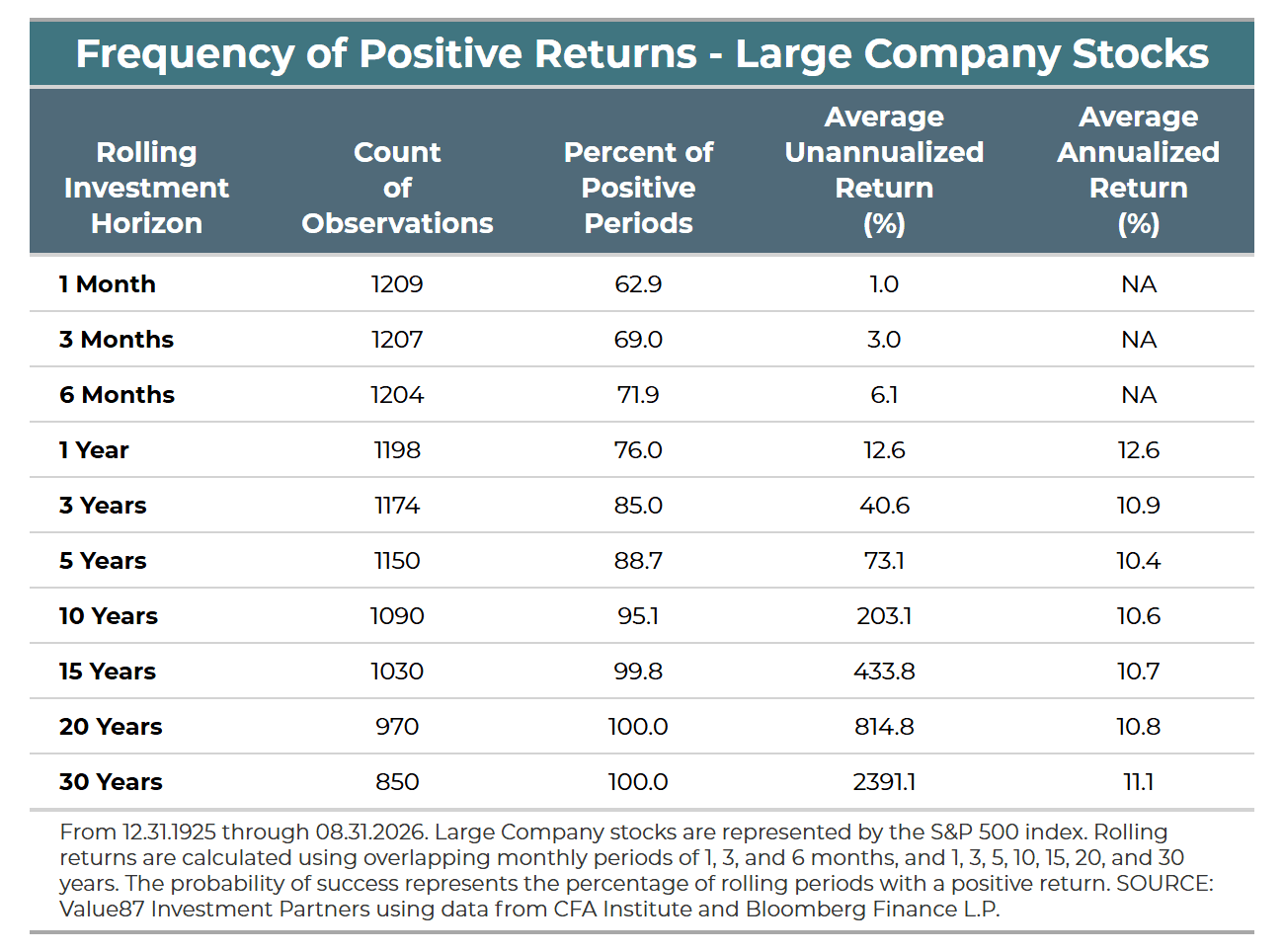
Of course, the future could be different, but historically positive S&P 500 periods have occurred more frequently over the longer measurement periods shown above.
We’ll note, of course, that one cannot invest directly in an index and individual stock performance varies, but the stock market has historically been a compounding machine moving money from the impatient to the patient.
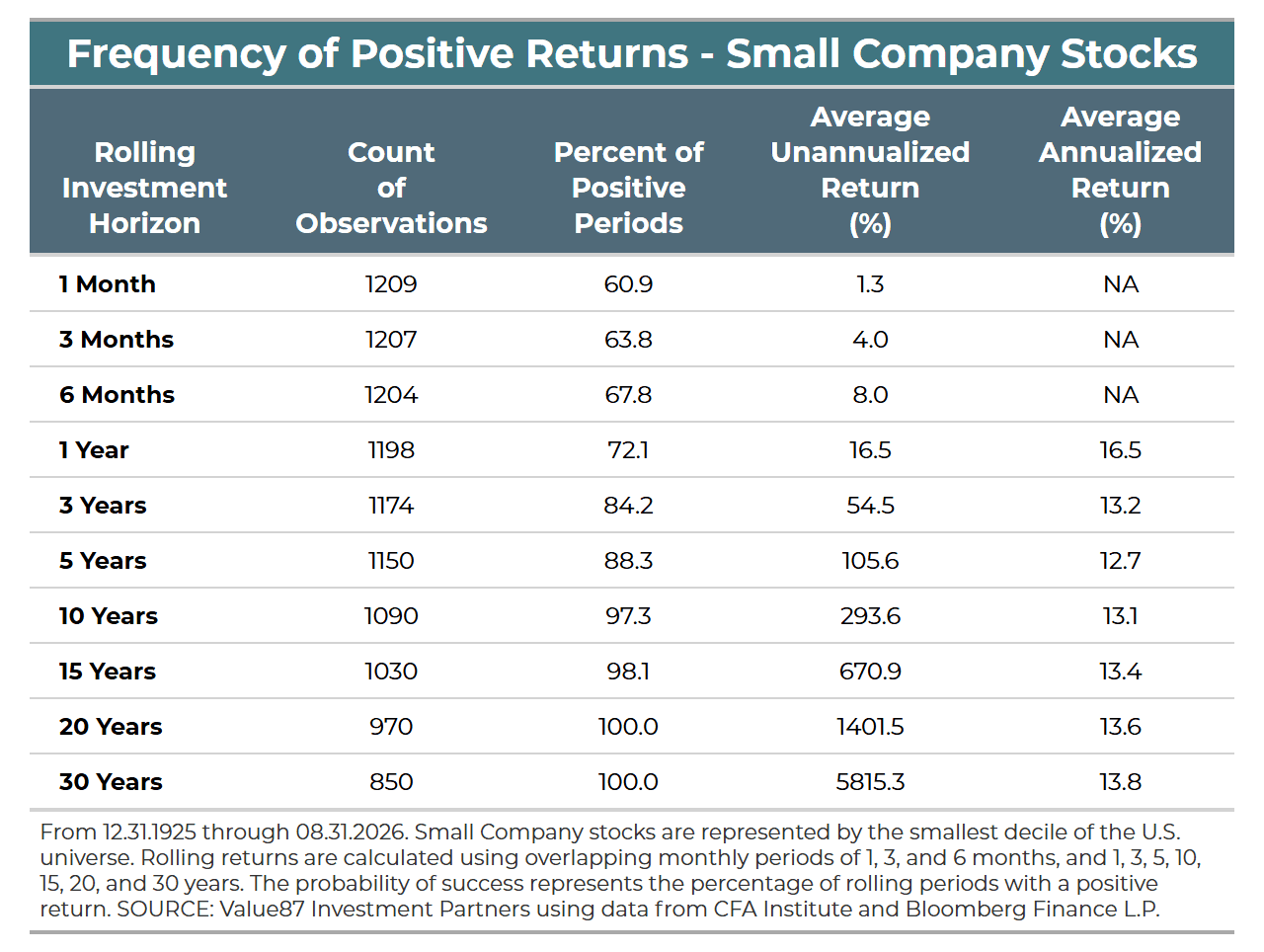
We ran the same math as in the previous figure, but used the return series for Small Company stocks instead.
Why One Month Tells You Almost Nothing
A one-month holding period is usually too short for Value investing to work.
Even if a company releases strong results, the stock may decline because of interest rate changes, investors reallocating capital, company guidance updates, geopolitical issues and a nearly infinite number of other reasons. Yet none of these events necessarily changes the long-term value of the business.
This is the central mismatch between long-term Value investing and short-term measurement. An Value investor may be evaluating five years of potential cash flows, while the market is reacting to today’s news or next quarter’s outlook.
Patience Is Not the Same as Blindly Holding
Patience does not mean refusing to sell. A Value investor should continue monitoring their original thesis. The investment deserves patience only while the underlying facts remain favorable.
The right mindset is not “hold forever.”
It should be along the lines of “Hold while the business is healthy, the balance sheet is sound, the price remains attractive and your thesis is intact.”
That distinction helps separate patience from stubbornness. We have certainly had our share of losses, and there is nothing inherently wrong with taking one. Sometimes the better decision is to take your ball and go home or, more appropriately, put that capital to work elsewhere. But the decision should be measured against the opportunities available for that capital, rather than simply the frustration of watching a thesis take longer than expected to work out. A disappointing outcome is not, by itself, a compelling reason to sell.
A Simple Framework for Deciding Whether to Wait
Before buying a Value stock (or any stock for that matter), we think it’s important to write down the reasons one believes the investment will succeed. Then identify what would could go wrong.
This creates a written investment framework instead of an emotional reaction to price movements. We are constantly evaluating our theses (and Goal Prices) as new information becomes available. This flexibility is a valuable part of the process, and we share some of that thinking in our Newsletter or Monday morning Market Observations.
The Real Secret Behind Value Investing
Buying a “cheap” stock is not the same thing as buying a “Value” stock.
It is combining four disciplines:
- Buy a business for less than a reasonable estimate of its value.
- Require a margin of safety (we do this in part by explicitly considering risk).
- Evaluate the business rather than focusing on the price.
- Give the investment enough time to work.
Patience cannot rescue a bad business bought at an unreasonable price.
But when patience is applied to a healthy company with durable economics and an attractive valuation, it becomes a genuine competitive advantage. We often find that investors are unwilling to wait through periods of uncertainty.
That creates opportunity.
Some of our biggest winners have do not look very exciting. The can be boring companies, they may have warts and sometimes they are the baby that is thrown out with the bath water. What they all have in common is that we were prepared to wait for the fullness of time for the market to assign a fair value to a stock.
For the patient investor, time is not an inconvenience. It is an integral part of the investment strategy.
A Patience Premium
The longer an investor’s time horizon, the less important short-term market sentiment tends to be. A one-month holding period is largely a bet on market mood. A 10- or 20-year holding period gives earnings growth, dividends, reinvestment and valuation normalization much more time to influence the result.
Important Information
This article is provided for educational and informational purposes only and reflects our views, observations and investment philosophy. The investment principles, strategies and observations discussed are not guarantees or predictors of investment success. There can be no assurance that patience, a longer holding period, value investing or any other investment approach will result in profitable investment outcomes or protect against loss.
Investing involves risk, including the possible loss of principal. Past performance and historical market results are not indicative of future results. Longer holding periods do not assure positive returns or eliminate or reduce the risk of loss. Market conditions, investment opportunities and future results may differ materially from those reflected in the historical information presented.
Historical returns, frequencies and other market data presented in this article are provided for informational and illustrative purposes only. Historical frequencies of positive or negative returns should not be interpreted as forecasts, projections or probabilities of future investment results. The fact that an investment, asset class or market has historically experienced positive returns over a particular period does not mean that it will do so in the future.
Historical market data and other information presented in this article may be obtained from third-party sources. We do not control third-party sources and do not independently verify or guarantee the accuracy, completeness or timeliness of their data or content. Third-party information may change, be revised or contain information that is inaccurate or incomplete.
Index information is presented for informational and comparative purposes only. Indexes are unmanaged and are not available for direct investment. Index performance does not reflect the deduction of investment management fees, transaction costs or other expenses that would reduce the returns of an actual investment. An index may not be representative of any particular investment, portfolio or investment strategy, and index performance should not be viewed as indicative of the performance of any investment or portfolio.
Valuation and investment analysis involve judgments, estimates and assumptions that may prove incorrect. Assessments of fair value, margin of safety, business quality, competitive position and other investment characteristics are subjective and may change as market, economic, company or other conditions change. A security considered undervalued may remain undervalued, decline further or result in a loss, and there can be no assurance that its market price will ultimately reflect an estimate of fair value.