
We always say it is a market of stocks and not simply a stock market, and the latest trading week vividly illustrates the point.
Despite The Wall Street Journal pessimistically summing up the week that was by writing,…
The S&P 500 and Nasdaq composite fell in every day of a calendar week for the first time since April 2024, losing about 2% and 4.6%, respectively.
The declines left even bullish investors seeing pressures that threaten the record run. Those include skepticism that artificial-intelligence companies will deliver profits that justify the billions of dollars being spent. They also include the prospect that borrowing costs will stay higher than many assumed.
“I just don’t think it’s a time as an investor that you should be focused on swinging for the fences,” said Jim Baird, chief investment officer at Plante Moran Financial Advisors.
Investors have been on edge since Kevin Warsh on June 17 signaled a greater concern about inflation than many expected in his debut meeting as chairman of the Federal Reserve. Traders increased bets that rates will rise this year instead of fall. Stocks slid.
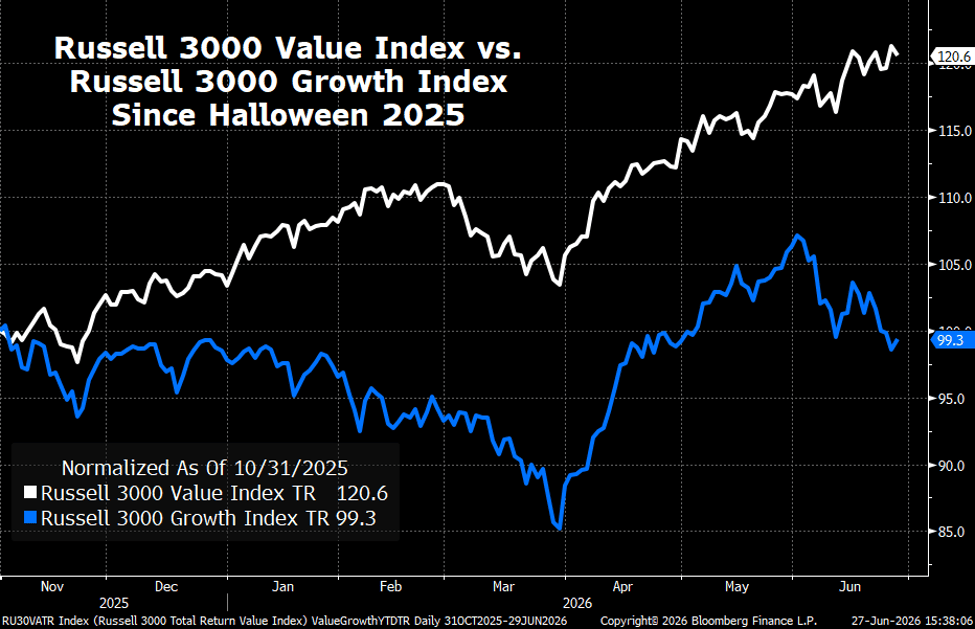
…the Russell 3000 Value index rose in three of the five sessions and ended the week modestly higher, outperforming on a total return basis (includes dividends and their reinvestment) its Russell 3000 Growth sibling by 375 basis points. The win in the latest relative returns race saw the Value benchmark add to its hefty lead since Halloween.
Interestingly, the proverbial soldiers outperformed the generals as well, with the S&P 500 Equal Weight index beating the market-capitalization-weighted S&P 500 by more than 350 basis points last week, which that same WSJ article pointed out was the biggest gap in favor of the average stock in a weekly return comparison since 2020.
And speaking of the generals, for the popular S&P 500 we note that the 10 largest components, representing a combined average weighting of more than 37%, have suffered a slightly negative performance contribution on a total-return basis when looked at as a group this year. That sounds depressing, especially given that so many are invested in index funds, but the overall cap-weighted S&P has managed a respectable YTD total return of 8.0%, so the bottom 490 stocks have been pulling their weight and then some.
Of course, the Russell 3000 Value index has returned 16.7% thus far in 2026, so it has been a very good year for those who pay attention to fundamental valuation metrics, providing more evidence as to why we will always believe that stock picking matters.
While we believe treading on the Value side of the fence affords more peaceful slumber, it is not lost on us that our portfolios have heavy AI exposure, with many incredibly fickle traders “playing” the theme. Indeed, it was quite a roller-coaster ride in the AI space last week, with plenty of red ink spilled on Friday, a day after superb gains were posted on Thursday, for many of the names in the chart below,…
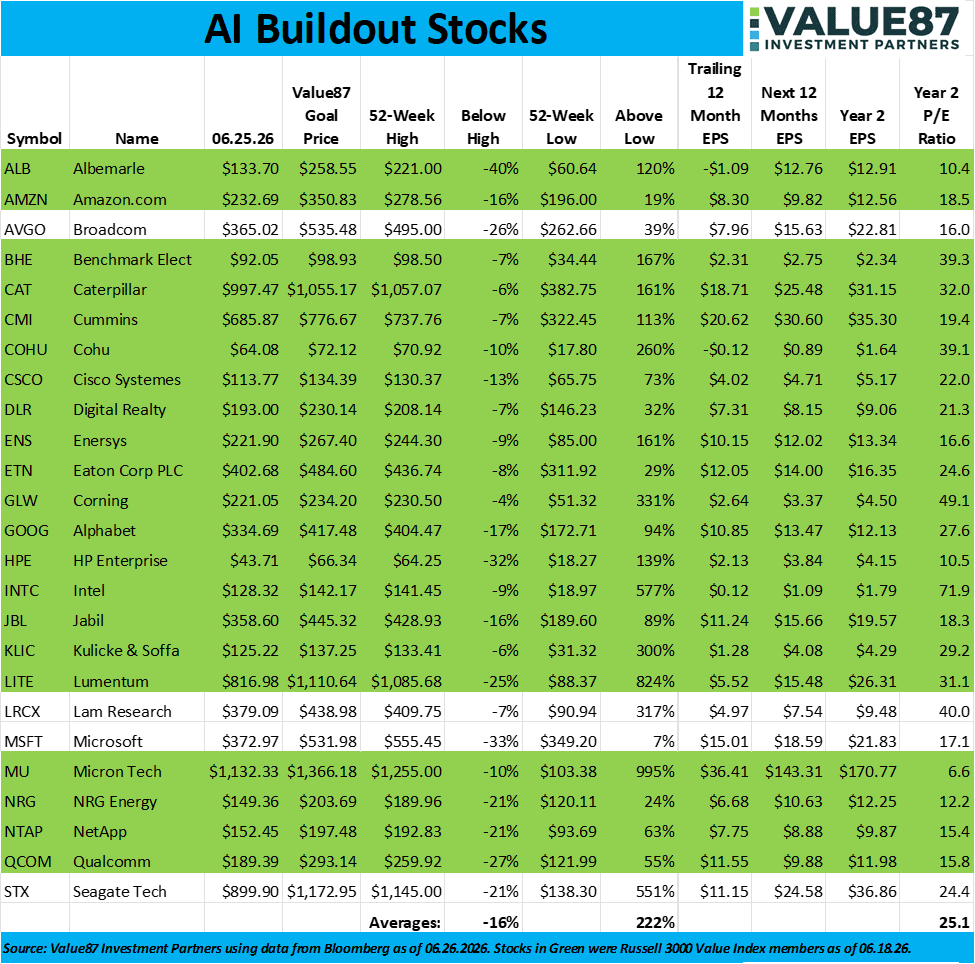
…offering a reminder of why we like our sell-a-little, keep-a-chunk partial-sale strategy. We find nothing wrong with cashing in a few of our chips on formerly undervalued stocks that have become momentum-investor favorites, growing to heavier weightings in our accounts. We also think that even with constant concern about better technological mousetraps emerging, along with worries of whether all the dollars spent on AI by corporations will produce solid returns on investment, it makes sense to maintain sizable exposure to businesses that still have terrific growth prospects and reasonable P/E ratios looking out a couple of years.
Speaking of a couple of the promising businesses that had a wonderful Thursday and a miserable Friday, Jason Clark writes…
Shares of Micron (MU) saw wild swings last week before ending essentially flat, despite a big spike following its fiscal Q3 blowout earnings report. The memory chip producer reported quarterly revenue of $41.5 billion, $6.2 billion above the consensus estimate and an astonishing 346% greater than the year ago tally. Adjusted EPS of $25.11 beat the consensus projection of $20.49 by more than 22%. Adjusted gross margin reached a record 84.9%, well above the 81.2% that was expected. The beat was driven almost entirely by pricing rather than volume, as industry shortages in both DRAM and NAND drove price increases. All four of Micron’s business units posted record revenue, with the Cloud Memory unit at $13.8 billion, Core Data Center at $11.5 billion, Mobile and Client at $11.5 billion, and Automotive and Embedded at $4.6 billion. MU said total data-center revenue exceeded $25 billion.
While the quarterly results were very impressive, the forward guidance stole the headlines. MU guided Q4 revenue to approximately $50 billion (vs. $43.2 billion consensus) and adjusted EPS of approximately $31.00 (vs. ~$25.30 consensus), with gross margin guided to roughly 86% against an 83.6% estimate.
Management characterized demand conditions as unprecedented, noting that customer requests for volume extend well into 2027 and beyond, far exceeding the company’s current ability to supply. Micron also announced 16 Strategic Customer Agreements structured as take-or-pay contracts with binding financial commitments and cash deposits, covering 20% of DRAM volume and 33% of NAND volume through 2030. Those deals are expected to generate $100 billion in revenue over their remaining terms.
Management said it now expects $27 billion to be spent on Cap Ex for full-year 2026, with substantial increases planned for 2027 and more than half earmarked for construction and efforts to meet long-term demand. MU’s balance sheet reached a record $30.2 billion in cash and investments and now has a net cash position of $24.4 billion after the company paid down debt by $4.4 billion in the quarter.
Even after the more than 800% return over the last year, we see Micron as a compelling long-term holding as demand for high-bandwidth memory (HBM) and DRAM continues to benefit from the rapid buildout of AI infrastructure. And the bottom-line acceleration has been so impressive that MU is priced at less than 8 times NTM adjusted EPS projections.
While the memory business will always be highly cyclical and the proverbial music could stop before expected (one reason why we have been occasional trimmers of our position), Micron has strengthened its competitive position through technology leadership, disciplined capacity management and a growing mix of higher-value products. Our V87 Goal Price has been hiked to $1,366.
Shares of semiconductor and telecom equipment maker Qualcomm (QCOM) fell more than 16% last week, as a sharp selloff in semiconductor stocks overshadowed what was otherwise a constructive Investor Day. Management outlined a somewhat aggressive long-term strategy centered on AI and data-center computing, raising its 2029 target for non-handset revenue to $40 billion from $22 billion previously, including more than $15 billion of expected annual data-center revenue. The company also introduced its Dragonfly server platform, announced a multiyear CPU partnership with Meta Platforms, and expanded its AI software capabilities through the acquisition of Modular.
We see the announcements as a continuation of Qualcomm's efforts to diversify beyond smartphones and position itself as a meaningful participant in AI infrastructure. While the market's attention last week was focused on broader fears surrounding chip-sector valuations, we believe the more important takeaway is that Qualcomm continues to leverage its technology leadership and strong financial position to pursue potentially attractive long-term growth opportunities.
As always, execution will determine the ultimate outcome, but the company's strategy appears increasingly compelling from a long-term-investment perspective. Current EPS estimates for full-year 2027 and 2028 are $10.89 and $12.86, resulting in very reasonable adjusted P/E multiples. Our V87 Goal Price for QCOM now resides at $293.
While the WSJ snippet cited above did not mention Iran, renewed hostilities in the Middle Easton Friday and over the weekend add to the uncertainty facing market participants. This is nothing new as the crystal ball is always murky when it comes to the near-term direction for stocks and we don’t disagree that there is plenty to worry about these days, so we don’t mind having a little more cash than usual in our broadly diversified portfolios as we await opportunities to redeploy the proceeds of recent sales and the steady stream of dividends our accounts have been receiving.
Yes, some may accuse us of forgetting our constant admonition that time in the market trumps market timing as stocks heretofore have overcome all scary headlines in the fullness of time,…
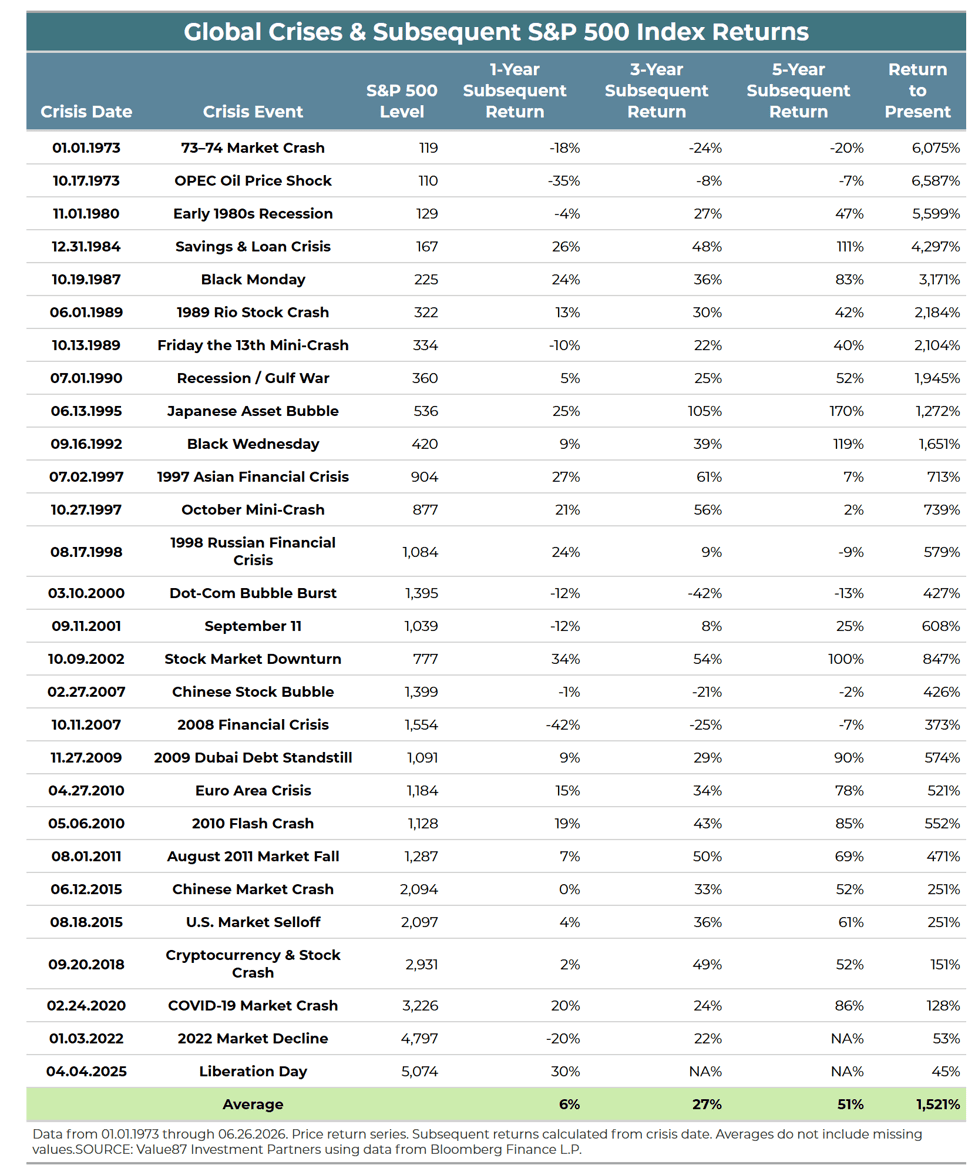
…but each of 2023, 2024, 2025 and 2026 (so far) enjoyed excellent returns, while we like having a little dry powder as selloffs, corrections and even Bear Markets also have long been part of the investment process.
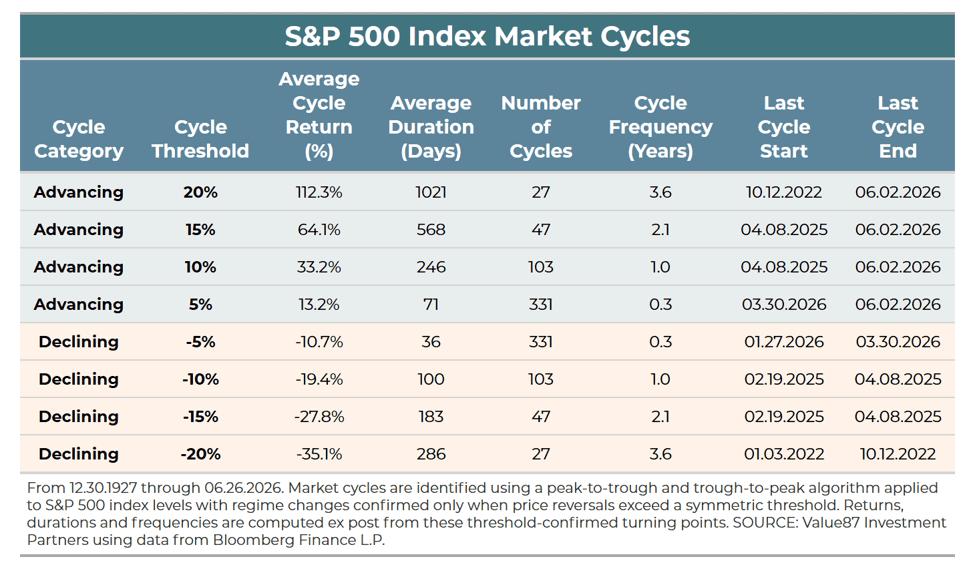
And, while we know from the historical evidence we have compiled in the past that stocks have performed well, on average, whether inflation is rising or falling, we realize that elevated consumer prices are one of the bogeymen spooking the financial markets these days. New Federal Reserve Chair Kevin Warsh & Co. have been talking tough on inflation, and the Fed’s preferred measure, the core PCE, inched up to an increase of 3.4% for May, well above the central bank’s long-stated 2% target.
When the topic of inflation comes up, energy prices often dominate the headlines because they're one of the most visible and frequent costs consumers face. However, energy prices account for a relatively modest share of the major inflation gauges. Energy represents roughly 4% to 5% of the Personal Consumption Expenditures (PCE) Price Index, and approximately 6% to 7% of the Consumer Price Index (CPI). Both Core PCE and Core CPI exclude energy as well as food in an effort to provide a clearer picture of underlying inflation trends.
While that means the swings in oil and gasoline prices, like we have experienced lately, don't directly affect the core inflation readings, energy's influence extends far beyond its weighting in either index. It's difficult to think of many businesses that don't consume energy. It powers factories, transports raw materials and finished goods, fuels airlines and trucking fleets, and keeps offices, warehouses and retail locations operating. When oil prices surge, companies often attempt to recover at least a portion of those higher input costs through increased prices for the goods they produce and services they offer, with both of those inputs part of the core inflation calculations. On the flip side, when energy prices decline, as we've recently seen with crude oil falling more than 35% from its recent highs and wholesale gasoline prices retreating more than 20%, those cost pressures gradually begin to ease.
However, the relationship is rarely immediate or one-for-one, as some companies absorb higher costs through margins while others hedge fuel purchases or delay pricing adjustments. Nevertheless, sustained moderation in energy prices should provide a meaningful retreat in inflation readings by easing cost pressures across the broader economy.
No single report will determine the Federal Reserve's next policy decision, but we can’t ignore that lower energy costs should be a favorable influence on inflation calcs. As such, the Fed Funds futures market last week saw a sizable reduction in the number of hikes in the Fed Funds rate likely over the next 12 months, while the yield on the benchmark 10-year U.S. Treasury fell to 4.37%, down from 4.45% at the end of the week prior.
While the historical evidence shows that stocks perform well, on average, whether interest rates are rising or falling, supposed market experts would be quick to argue that lower rates are beneficial for equities…which is why the S&P 500 was down every day last week. Oops!
Obviously, many factors influence stocks, so we are always braced for downside turbulence, but we note that the estimate for Q1 U.S. real (inflation-adjusted) GDP growth was revised up last week to 2.1% from an initial guess of 1.6%, while the latest estimate from the Atlanta Fed for Q2 GDP growth stands at 2.5%, which bodes well for the outlook for corporate profits. In fact, earnings per share estimates from data provider Bloomberg for the S&P 500 were ratcheted higher last week to $294.16 for 2026, $343.40 for 2027 and $398.57 for 2028, up from $269.24 in 2025.
Time will tell whether analysts are high in their predictions, but we continue to offer the reminder that stock prices historically have followed earnings up and down.