
While this writer confesses to making numerous appearances on the network over his 39-year career, it is always fascinating to hear the talking heads on CNBC TV explaining with remarkable precision why stocks were rising or falling on a particular day. No doubt, financial pundits desire to sound intelligent, and they often imply that whichever direction stocks are moving is logical, but no one ever knows for certain what will drive short-term price movements.
The easiest answer to what might be moving the markets is usually something like more buyers than sellers, or vice versa, but there are always two participants in every trade, so better-sounding explanations are always demanded. As such, those charged with educating viewers generally see whether stocks are in the green or in the red and then find a headline or two to justify that direction.
Such was the case last week, when a big plunge of 953 points in the Dow Jones Industrial Average on Wednesday was blamed in large part on an increase in inflation. On the surface, that makes sense, given that the year-over-year Consumer Price Index (CPI) for May rose 4.2%, up from a 3.8% increase in April, but that was in line with expectations, meaning traders should have already priced this economic statistic into their thinking.
And the so-called Core CPI, which excludes volatile food and energy prices, rose 0.2% on a month-over-month basis in May, which was lower, yes lower, than the 0.3% rise that was estimated. So, one could argue that stocks should have rallied on Wednesday, following a better-than-projected CPI report!
True, the Wednesday selloff was exacerbated by word that the U.S. would resume attacks on Iran in the wake of renewed Iranian aggression, but the markets were already headed south that day long before President Trump posted on social media, “They’ve taken too long to negotiate a deal that would have been great for them, now they will have to pay the price!!!”
We also can’t ignore the pending launch of SpaceX, seeing as it was blamed for the equity market skid the week prior, with folks evidently taking profits and raising cash in the hottest areas of the market ahead of the much-anticipated IPO.
So, there were seemingly plenty of headwinds at mid-week to suggest that stocks might be headed for a 5% or greater retreat, with some market watchers warning that a 10% correction or worse might be in the cards…right before a big rally took place on Thursday when the White House said that U.S. strikes on Iran would be cancelled as talks of peace were back on the table. Never mind that a deal was supposedly about to be reached umpteen times before, the Dow roared back with a 900-point gain…and followed that rally with a 350-point jump on Friday, even with the completion of the SpaceX IPO adding a big chunk of equity supply to the market that morning.
Is it any surprise why we always say that the only problem with market timing is getting the timing right? Yes, there will always be selloffs, downturns, corrections and even Bear Markets, but history shows the favorable periods have been equally prevalent and returns during those periods in the green have dwarfed the losses during spans in the red.
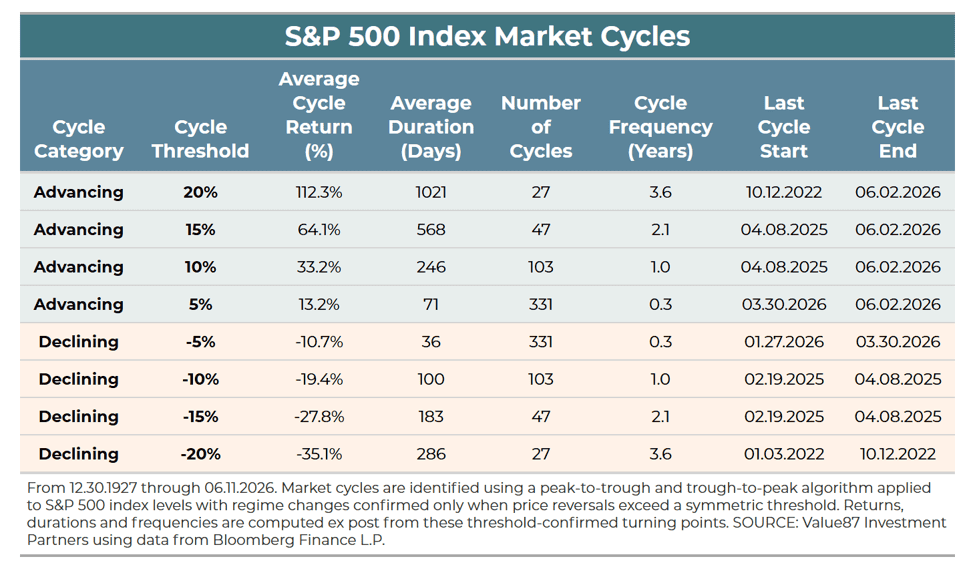
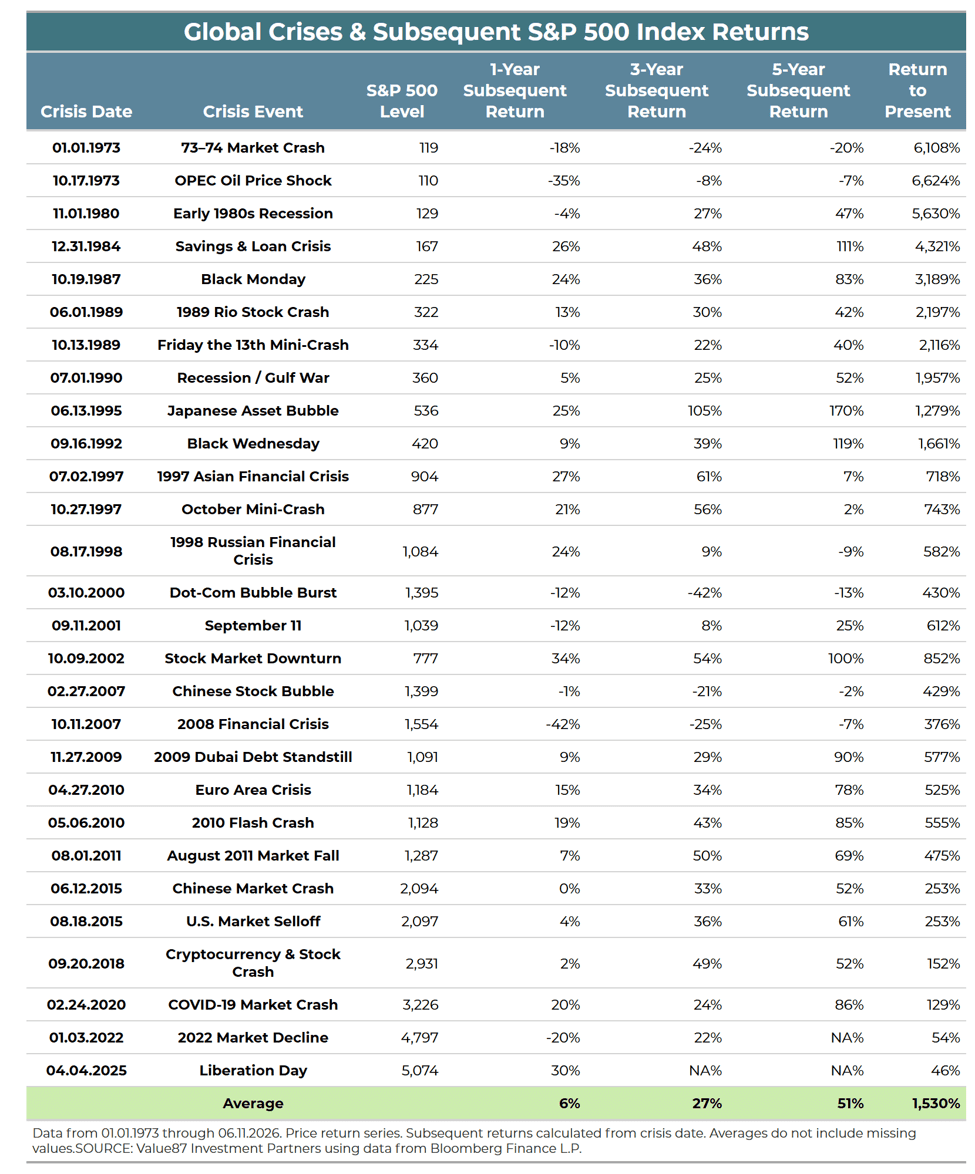
And, equities, in the fullness of time, have historically managed to overcome all scary events. No guarantee, of course, that history repeats, but the historical evidence for sticking with stocks no matter what the supposed experts might be saying about the short run is overwhelming.
We also can’t forget that it is a market of stocks and not simply a stock market, as the Russell 3000 Value index enjoyed a terrific five days of trading last week with a gain of 2.54%, even as its Russell 3000 Growth counterpart endured a loss of 0.74%. Performance figures available to us via data provider Bloomberg for those two equity gauges date back to 1995 and the 3.28% net victory for Value last week was the 38th best showing, right behind the 3.30% advantage posted the preceding week!
Certainly, it is nice to see Value enjoying quite a bit of time in the sun, and the Value lead over Growth in the Russell indexes since last Halloween has grown to 1,850 basis points on a total return basis (including dividends and their reinvestment), but we continue to like the valuation comparisons (we have access to Bloomberg metrics) and dividend yields for the kind of reasonably priced stocks we have long championed.
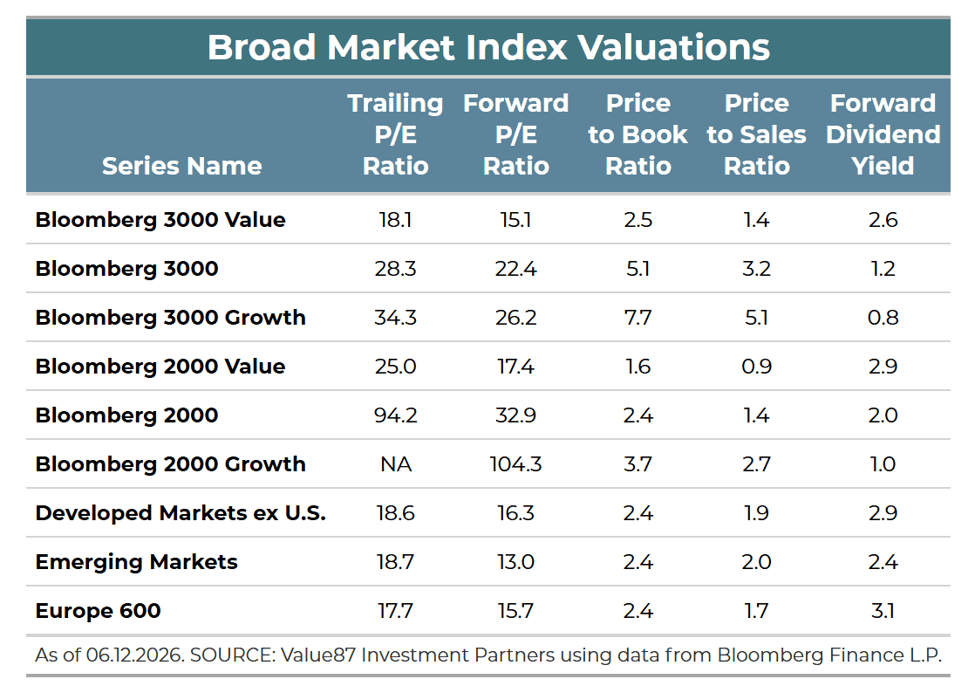
As always, we must remain braced for downside volatility, but whichever way stocks may move in the near term, we will continue to let others try to outguess the whims of fickle traders as we remain laser-focused on the long-term prospects of the businesses in which we have invested, all while endeavoring to take advantage of the opportunities that result from the trading gyrations.
Such has been the case since I came to work for Al Frank in 1987, with my mentor a firm believer in the teachings of Warren Buffett. Interestingly, the Oracle of Omaha offered words of wisdom in that same year’s Berkshire Hathaway Annual Report…
Ben Graham, my friend and teacher, long ago described the mental attitude toward market fluctuations that I believe to be most conducive to investment success. He said that you should imagine market quotations as coming from a remarkably accommodating fellow named Mr. Market who is your partner in a private business. Without fail, Mr. Market appears daily and names a price at which he will either buy your interest or sell you his.
Even though the business that the two of you own may have economic characteristics that are stable, Mr. Market's quotations will be anything but. For, sad to say, the poor fellow has incurable emotional problems. At times he feels euphoric and can see only the favorable factors affecting the business. When in that mood, he names a very high buy-sell price because he fears that you will snap up his interest and rob him of imminent gains. At other times he is depressed and can see nothing but trouble ahead for both the business and the world. On these occasions he will name a very low price, since he is terrified that you will unload your interest on him.
Mr. Market has another endearing characteristic: He doesn't mind being ignored. If his quotation is uninteresting to you today, he will be back with a new one tomorrow. Transactions are strictly at your option. Under these conditions, the more manic-depressive his behavior, the better for you.
But, like Cinderella at the ball, you must heed one warning or everything will turn into pumpkins and mice: Mr. Market is there to serve you, not to guide you. It is his pocketbook, not his wisdom, that you will find useful. If he shows up some day in a particularly foolish mood, you are free to either ignore him or to take advantage of him, but it will be disastrous if you fall under his influence. Indeed, if you aren't certain that you understand and can value your business far better than Mr. Market, you don't belong in the game. As they say in poker, "If you've been in the game 30 minutes and you don't know who the patsy is, you're the patsy."
Ben's Mr. Market allegory may seem out-of-date in today's investment world, in which most professionals and academicians talk of efficient markets, dynamic hedging and betas. Their interest in such matters is understandable, since techniques shrouded in mystery clearly have value to the purveyor of investment advice. After all, what witch doctor has ever achieved fame and fortune by simply advising "Take two aspirins"?
The value of market esoterica to the consumer of investment advice is a different story. In my opinion, investment success will not be produced by arcane formulae, computer programs or signals flashed by the price behavior of stocks and markets. Rather an investor will succeed by coupling good business judgment with an ability to insulate his thoughts and behavior from the super-contagious emotions that swirl about the marketplace. In my own efforts to stay insulated, I have found it highly useful to keep Ben's Mr. Market concept firmly in mind.