
With the Dow Jones Industrial Average soaring more than 1500 points on Wednesday, The New York Times proclaimed, “An end to uncertainty boosts the markets,” adding, “Stock markets gained on Wednesday, as it became clear that Democrats were set to seize control of Congress in a resounding midterm election victory that surpassed the party’s most optimistic expectations.” A market strategist in the story stated, “Markets hate uncertainty, and now with the election out of the way, we are seeing buyers step in across the board.”
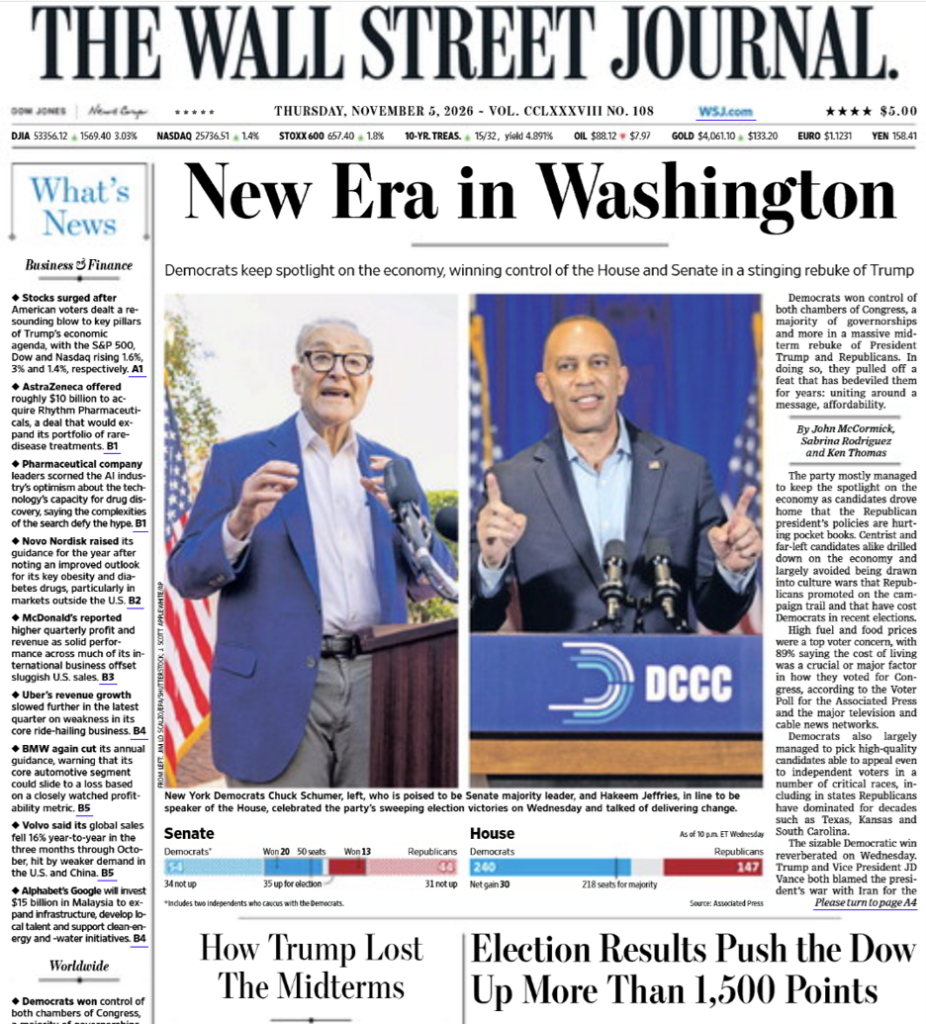
Of course, futures trading on Election night saw completely different headlines as the strong Democratic showing was supposedly going to be bad for stocks, illustrating why we say that those charged with explaining short-term market moves simply find a narrative to fit the direction, even if the same explanation could serve as justification for a rally AND a selloff.
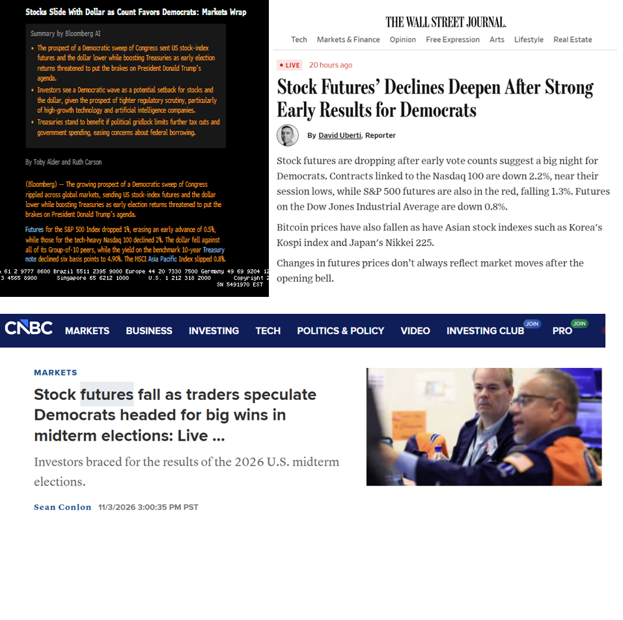
And speaking of a selloff, stocks were subjected to a doozie on Thursday, with The Wall Street Journal writing, “The new reality of artificial intelligence skeptics rising into power after the midterms slammed into Wall Street on Thursday, wiping out an estimated $2.5 trillion from the Nasdaq, the worst one-day value destruction in its history.”
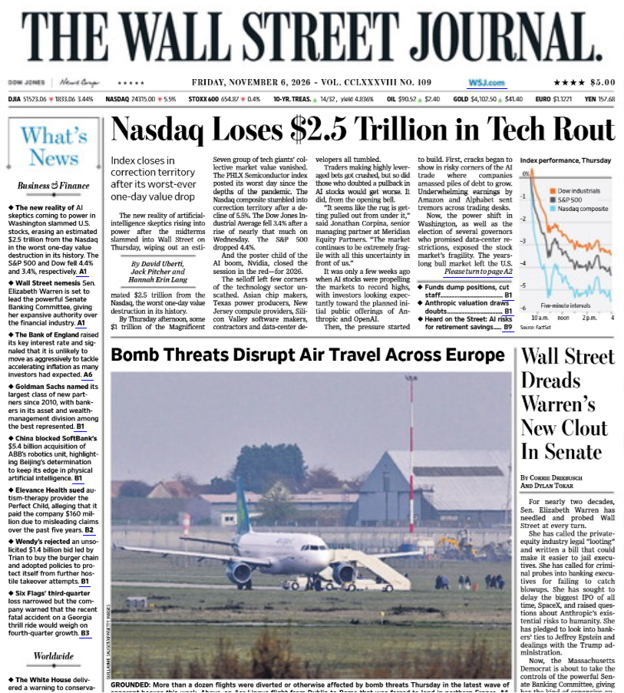
It wasn’t just Tech stocks that cratered that day, as the broad-based S&P 500 retreated 4.36%, the worst drop since “Liberation Day” back-to-back whacks of 4.84% and 5.97% on April 3 and April 4, 2025.
Believe it or not, as bad as it was on Thursday, the plunge was “only” the 123rd worst one-day drop dating back to 1928, meaning that declines of even greater magnitude have occurred more than once a year on average.
Yes, many of those prior skids were concentrated around big macroeconomic events like the Great Financial Crisis or the Covid-19 Economic Shutdown, but it is interesting to note that the average price return (not including dividends) for the S&P 500 one year later for those 122 instances has been 16.1%. This compares to an 8.2% average price return for all 12-month figures dating back 99 years.
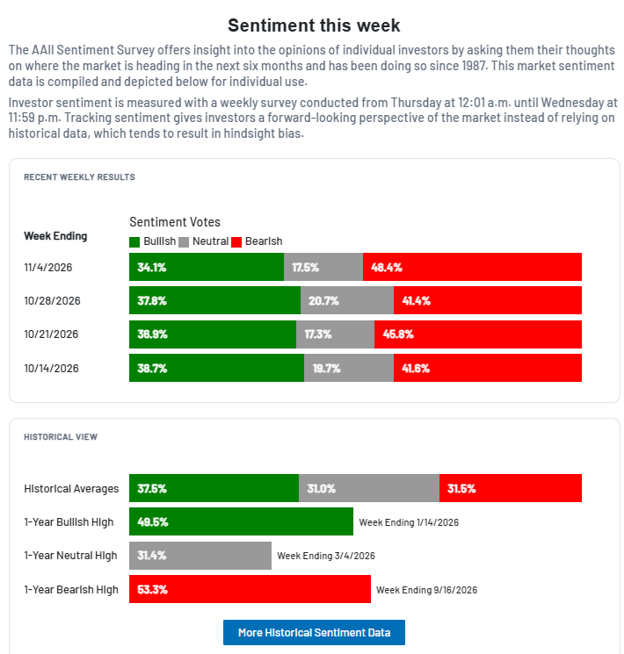
No doubt, there was plenty of hand-wringing surrounding Election Day, even as the betting odds had overwhelmingly suggested that the Democrats would take both the House and the Senate, but we respect that emotions typically run high when Americans go to the polls. Still, we offer the friendly reminder that the major equity indexes, despite this past week’s turbulence, are not far off their all-time highs, showing that markets have managed to move higher over the long term no matter the headlines or which political party is in power in Washington.
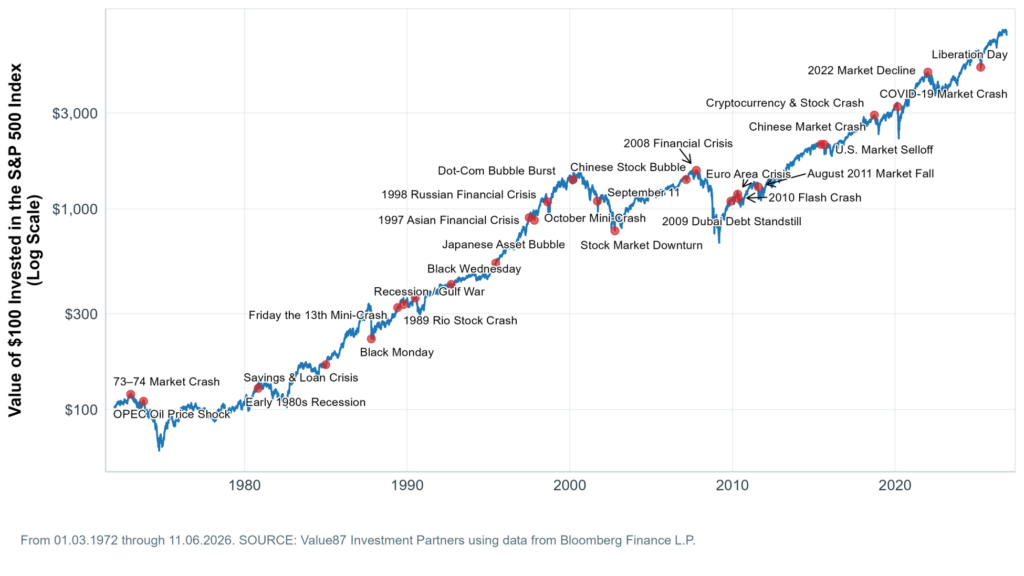
During election seasons, investors are often their own worst enemies considering progress towards their long-term financial goals. We offer a cautious reminder that what is repeated on the campaign trail doesn’t always make it through Capitol Hill and end up as policy, while history shows that markets have favored supposedly less-business-friendly Democrats controlling Congress versus supposedly more-business-friendly Republicans, with the same true of the Oval Office.
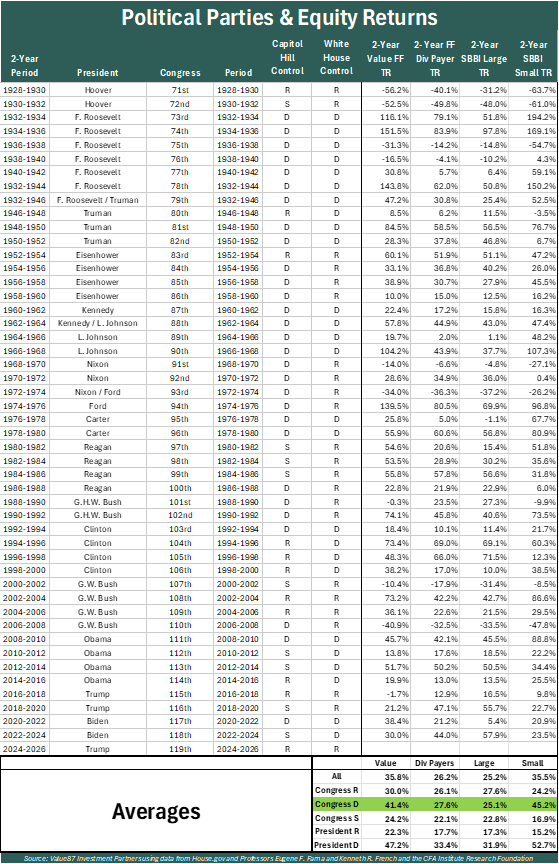
Yes, there are not a lot of data points and past performance is no guarantee of future returns, but your Editor has been at his Value Investing post now for 19 Congressional elections. In each case, the stakes were high and the sun came up for the world (and for our stocks) in the days, weeks and months that followed.
As is our custom, we have always remained partial to our approach of buying undervalued stocks and patiently holding them for the long term, trimming and harvesting the winners and pruning the losers along the way. It makes for more peaceful slumber as we firmly believe that the only problem with market timing is getting the timing right.
Of course, we respect that the big hit to stocks on November 5 was disconcerting, but we can’t forget that trips south happen each and every year,…
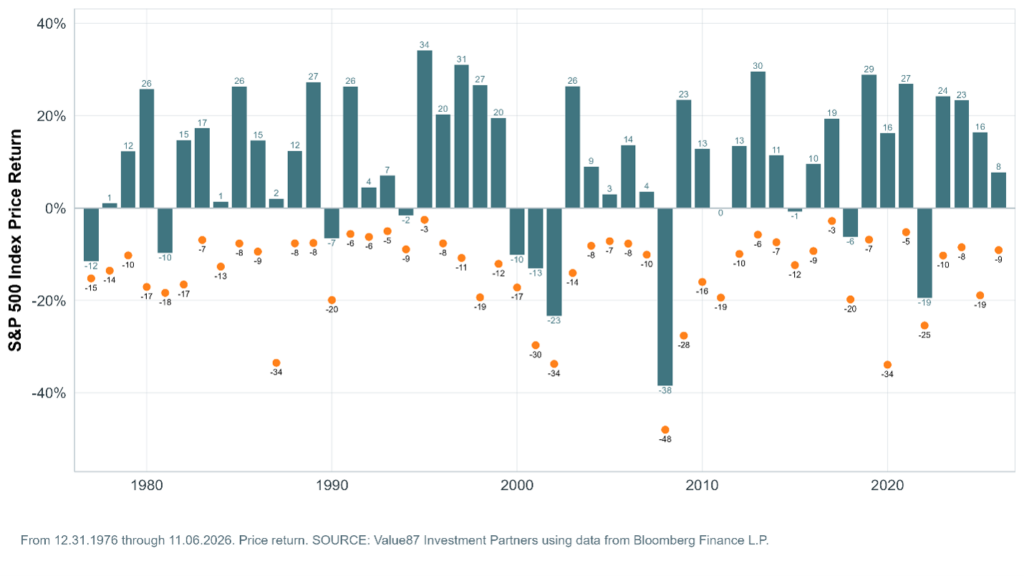
…with 5% pullbacks, such as the one in which we officially now reside, happening three times a year on average, 10% corrections taking place once a year and “official” 20% Bear Markets occurring every 3.7 years.
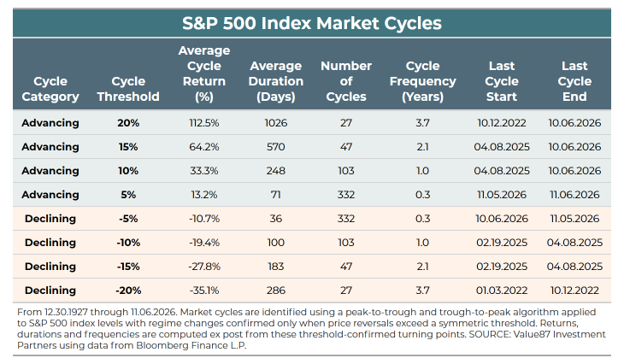
Happily, Bull Markets have come with equal frequency and they have lasted longer, with the gains during the periods in the green dwarfing the losses during the times in the red,…
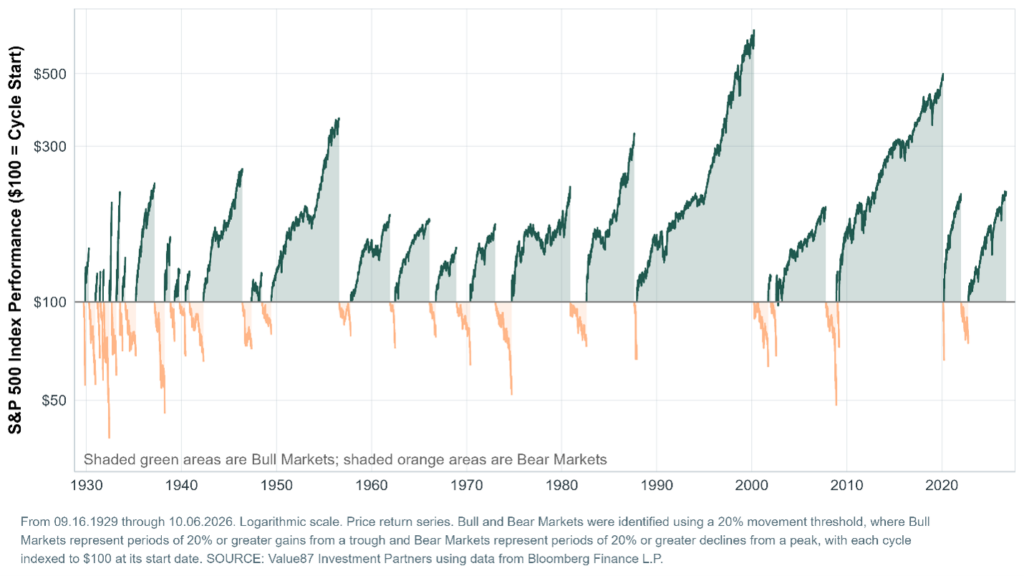
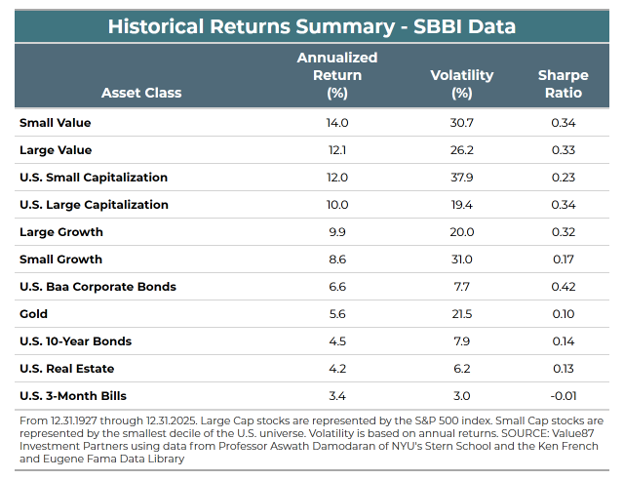
…so much so that returns on stocks, led by Value, have been terrific over the long term,…
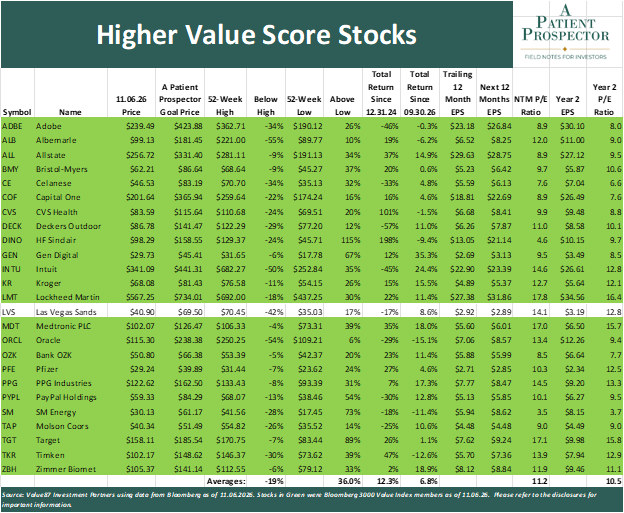
…and we note that traditional Value names have been performing relatively well, on average, since Q4 began, even as the returns for these stocks since the end of 2024 generally have been subdued.
Come what may, we continue to believe that the secret to success in stocks has been to not get scared out of them, so we have long favored the Vannevar Bush quotation, “Fear cannot be banished, but it can be calm and without panic; it can be mitigated by reason and evaluation."
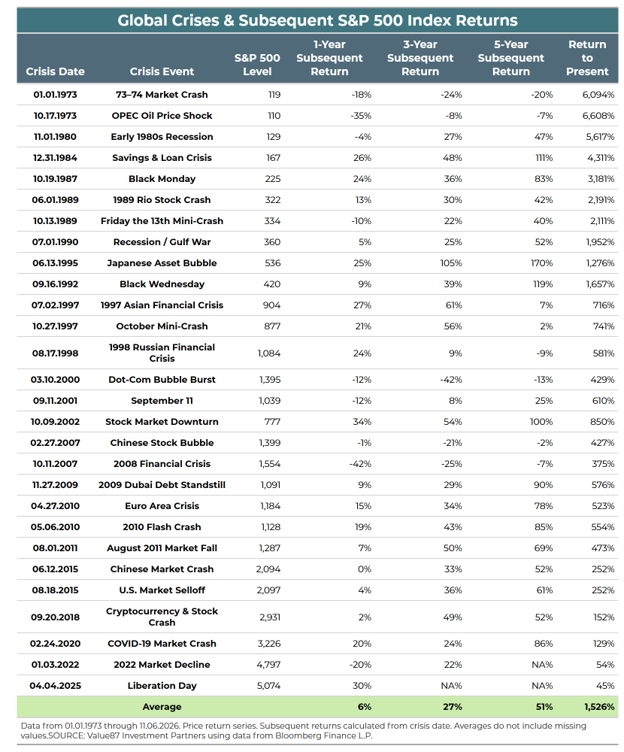
We realize that this time is different (it is always different), but as we think about reason and evaluation, stocks have overcome in the fullness of time all prior disconcerting events,…
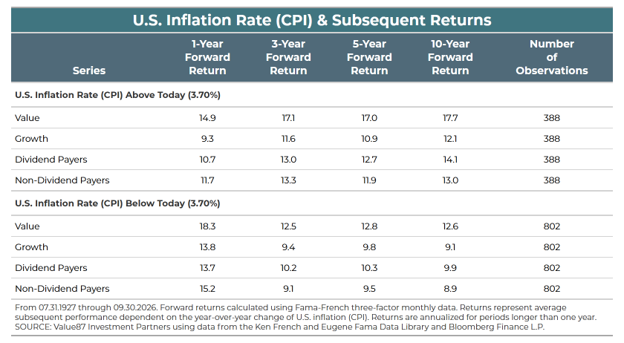
…while bogeymen spooking investors today like inflation,…
…higher interest rates,…
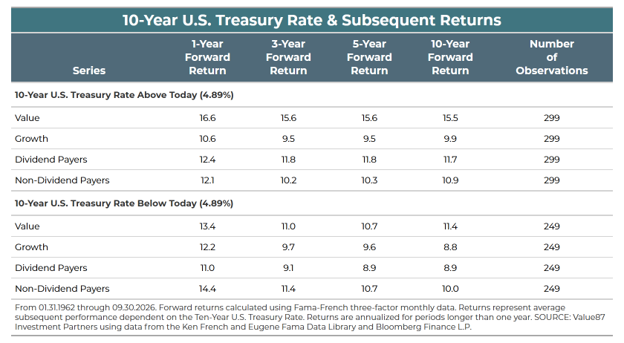
…and tighter Federal Reserve monetary policy,…
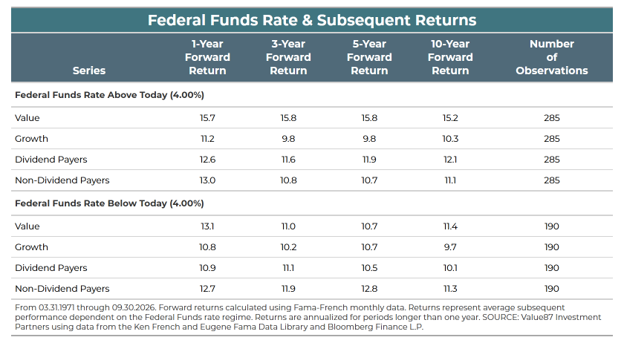
…heretofore have not been reason, on average, to sour on equities, with returns three, five and ten years ahead historically even better for Value stocks when all three data points were higher than today’s levels.
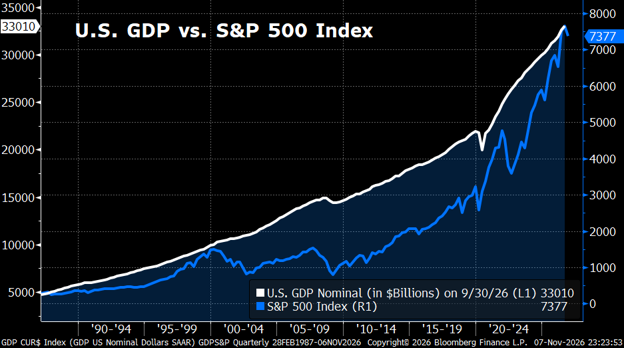
The reason stocks have proved rewarding over time is that corporate profits have grown,…
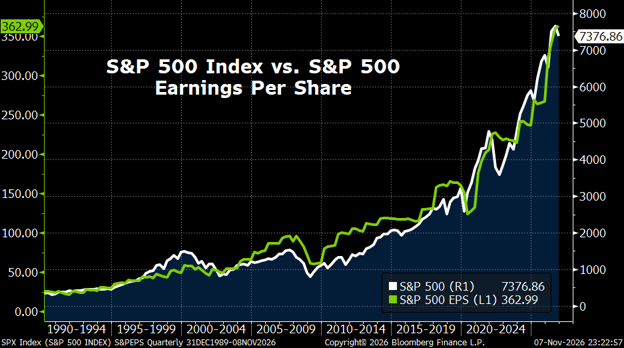
…as the U.S. economy has expanded,…
…with a favorable outlook for EPS,…
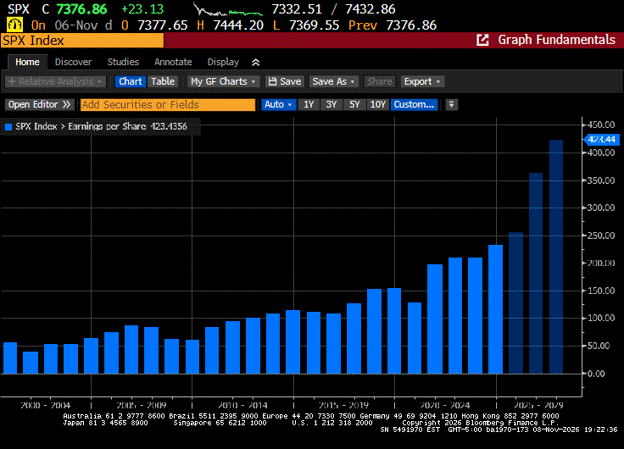
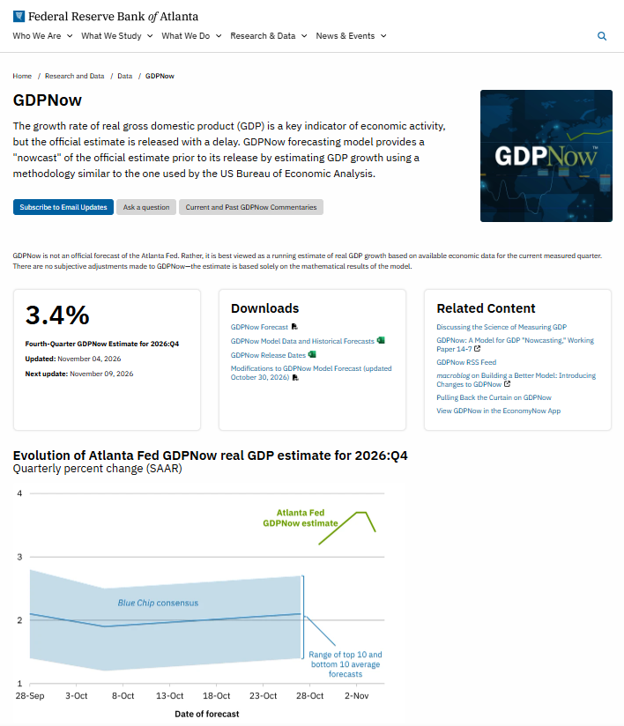
…and solid GDP growth still the consensus forecast,...
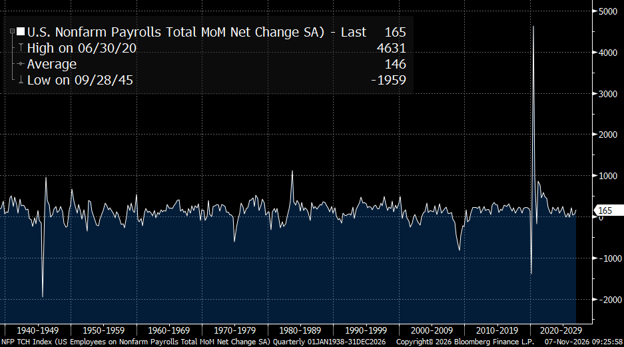
…while the important monthly jobs report for October saw an unemployment rate of 4.1% that was below the 4.2% projection and 165,000 new nonfarm payrolls created, above the consensus estimate,…
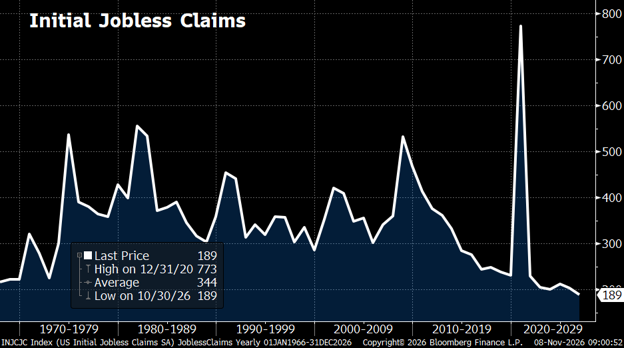
…and first-time filings for unemployment benefits in the latest week continued to reside at multi-generational lows.
To be sure, growth is never assured and we realize the Russia-Ukraine conflict and the Middle East hostilities are wildcards, but with energy prices having come down, interest rates having retreated and equity valuations becoming much more reasonable,...
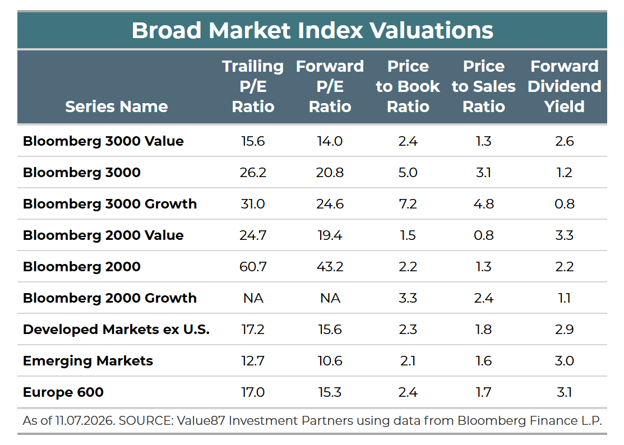
…we continue to think long-term-oriented investors should look at market gyrations as their friend and not the enemy. As Warren Buffett says, “Profit from folly rather than participate in it,” while the Oracle of Omaha also reminds us to be greedy when others are fearful.
No doubt, the Blue Wave has led to significant uncertainty about the growth of data centers, with 40 of 41 local ballot initiatives across the country that would limit or prevent data center development passing, prompting one industry watcher to state, “Expect a tsunami of new rules and oversight.”
Fickle traders, many of whom have been playing with borrowed funds and utilizing levered instruments, voted with their feet post-election, choosing to shoot first and ask questions later, with some AI Buildout Stocks enduring a Bear Market…last week!
We are not suggesting that worries about debt (and equity) funding and new ROI calculations impacting long-term capex investment are unfounded, but we think the AI infrastructure build is still in the early stages as strong demand coupled with capacity constraints and a shortage of power are likely to lead to an elongated cycle, even if some data center projects are delayed or even cancelled.
And we doubt the Democratic bite will be as bad as the bark that has led to massive declines from the recent highs in AI stocks. True, Texas Governor-elect Gina Hinojosa is promising to pause new data centers but she said late last week, "We have always been a pro-business state in Texas, but what changes now with me as governor is it has to be a partnership that benefits Texans. Right now what has happened is data centers have moved into mostly rural communities, and there are no rules and laws to protect Texans, and Texans are being taken advantage of."
But it important to note that Ms. Hinojosa can really only take action on future data centers. As quoted in a story published on the ABC 13 Houston website, Nancy Sims, a political science lecturer at the University of Houston, said, "You can't really freeze mid-construction. They've been granted their permits. They've been granted their tax abatements. And you can't, as governor, go in and repeal those right away. What she can do is put a moratorium on new data centers.”
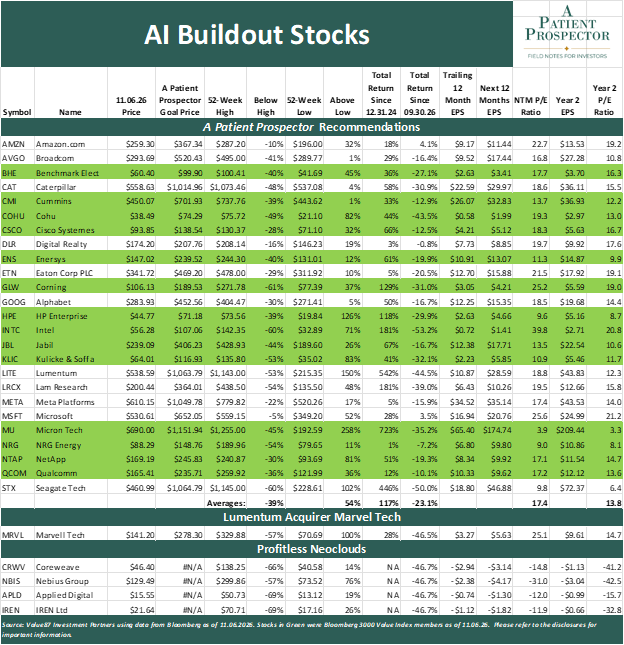
Yes, a moratorium would hit data-center growth projections and potentially impact pricing power for those businesses involved in AI infrastructure, while we respect that tech hardware industries have long been cyclical, the latter part of the reason we took some of our chips off the table over the past year or two on most of the 25 A Patient Prospector Recommendations in the AI Buildout chart below.
Still, we tend to agree with Dr. Lisa Su, CEO of chipmaker AMD, who said last week, “What I look at is in the long term, if you believe, which I do, I believe very deeply that computing, in many ways, equates to intelligence. So the more compute you have, the more intelligent your company is, the more problems you're going to be able to solve, the more you're going to accelerate your business.”
Dr Su added, “I think the market can sometimes be a little bit short-sighted. It is what it is,” but we can’t complain too much about the volatility in AI stocks, given that many folks paid little attention to financial fundamentals on the way up and the average return for the AI Buildout list since the end of 2024 has been in the triple digits. Further, we understand that high-flying stocks often ride an escalator up and an elevator down, as evidenced by what has transpired over the last 7 trading sessions with Lumentum (LITE - $538.59), shares of which fell 42% but are still up more than 500% over the past 22 months.
One might have thought that the optical-components maker must have had some terrible news to account for the drubbing, but that was hardly the case. On October 28, Lumentum agreed to be acquired by Marvell Technology (MRVL - $141.20), a producer of networking and AI chips, in a $115 billion all-stock deal. Believe it or not, on the announcement date, the transaction penciled out to roughly $1,130 per share of LITE common stock, based on each Lumentum share receiving 4.5 MRVL shares, a 24% premium over that day’s closing price.
Obviously, both stocks have been caught up in the AI-related carnage, but LITE also posted a strong FQ1 2027, including adjusted EPS of $4.57 (vs. $4.22 est.) and revenue of $1.26 billion (vs. $1.25 billion est.). Fiscal Q2 guidance was for $1.575 billion to $1.625 billion of revenue with $5.90 to $6.20 of EPS, both nicely above expectations.
“Lumentum built on its strong momentum in the first fiscal quarter of 2027, delivering growth across all our businesses, with pump lasers and optical circuit switches (OCS) being the leading contributors. During the quarter, we secured our second major NPO/CPO win, backed by purchase commitments exceeding $5 billion. Additionally, our OCS demand visibility has expanded significantly in recent months, positioning optical switching to become a multi-billion-dollar annual revenue stream. Finally, we continue to see strength in our cloud modules business which is showing improvement on the gross margin line,” said President and CEO Michael Hurlston.
"Looking ahead, we anticipate adding approximately $350 million in sequential growth in our second quarter, a figure greater than the quarterly revenue of the whole company just two years ago. Furthermore, we project our second quarter operating margin to exceed 45 percent.”
In an ordinary market environment, the merger transaction, strong operating results and better-than-expected fiscal Q2 guidance should have sent the shares higher, but such was not the case as Bloomberg News calculated that Marvell and Lumentum had lost a combined $140 billion in market capitalization since October 28 and questioned the deal’s wisdom amid mounting pressure on AI companies.
While we understand that many market participants bail at the first sign of trouble, we think the recent devastation inflicted on LITE was unjustified. We see tangible benefits from the Marvell union and like that on a stand-alone basis, consensus EPS estimates for Lumentum the next three years stand at $28.59, $43.83 and $62.58, putting a Year 3 P/E ratio in the single digits. True, we won’t be surprised if those numbers prove to be overly optimistic, and we have trimmed our Goal Price for LITE to $1,064, but that would imply significant upside potential from the current price.
Also, given that if the deal goes through, we would receive MRVL shares, we are including the current EPS metrics and Goal Price for that company in our updated AI-Buildout tables. Profit forecasts are always subject to revision and we realize that analysts are still reacting to the Blue Wave, but we think the stocks we are recommending generally are trading at inexpensive valuations.
Such is not the case for all AI infrastructure names, so our table also now includes the consensus earnings projections for profitless neocloud companies CoreWeave, Nebius Group, Applied Digital and IREN Ltd, shares of which we are NOT recommending.
Stocks in the News