
It is hard to believe that 25 years have passed since your Editor turned down Fifth Avenue from 17th Street in Manhattan on what had been a beautiful Tuesday morning in Manhattan only to see that a plane had crashed into the World Trade Center. Having arrived a few minutes early for a meeting about our investment newsletter at the old Forbes HQ, the firetrucks screaming by caused me to poke my head outside just in time to see another plane hit the second tower.
Still not certain what exactly had happened and operating in a world without 24/7 smartphone alerts, we proceeded with our meeting only to be interrupted with word that the first tower had collapsed…and then that the second tower had fallen. Needless to say, that put an end to the meeting and I followed our host, long-time Forbes Editor Jim Michaels, to the newsroom to learn more about what had transpired.
While I was understandably shaken up and I witnessed more than a few folks covered with ash and dust as I headed back to my hotel in Union Square, I did have the good sense to quickly grab one of the last rental cars available in case it was needed, even as New York City quickly shut down the subways, trains and bridges. I was also somehow able to call my wife back in California as I had the good fortune to have a Nextel cell phone that did not have the same demand on its towers as did most New Yorkers with their Verizon phones.
Eventually, the news reported that the George Washington Bridge was going to open so my travel companion and I set out in our rental car, driving up an eerily silent Park Avenue to head over to the West Side Highway, where we joined thousands of other cars in gridlock as we waited for the Bridge to open. Listening to the news, we began to understand what had occurred, but we didn’t know if more attacks were imminent so it was a shock to hear the radio announcer say that a truck with explosives had been stopped on George Washington Bridge...while we were inching our way across that very same bridge.
Happily, that turned out to be a false alarm, and our drive back to our company offices in Minnesota was uneventful, though getting back to California was another matter. The media reported that the airports would reopen on that Thursday evening, so off to MSP I went, only to be told just as I was about to board my flight that there was an intrusion in U.S. airspace and all flights were grounded. I waited around at the gate only to see the ashen-faced flight attendants deplane. I asked them when they thought we would be able to fly again, and one responded, “Never!”
At that point, two other Orange-County-bound passengers, one a Pakastani fellow and the other wearing a cowboy hat, and I started talking. I told them I had rented a car in Manhattan to get to Minneapolis and I was thinking of doing it again to complete a cross-country drive. The three of us decided to give a road trip a try and we set out for California, only to learn 90 minutes into our journey that the airports were going to reopen the next morning. While the three strangers were enjoying each other’s company, and the conversation was very enlightening, we turned around and headed back to MSP, with uneventful flights the next day finally returning us home.
Of course, my personal trials and tribulations on 9/11 paled in comparison to what many endured, but having begun my investment career less than nine months before the Crash of ’87, it is fair to say that I have seen a frightening event or two since I was hired by the late-great Al Frank.
A legendary value investor, Al was anointed The Zen Master of Money by Worth Magazine as patience and courage in navigating the ups and downs of the stock market were his hallmarks. Alas, my mentor passed away seven months after 9/11 and James K. Glassman wrote in Al’s New York Times Obituary:
I never met Al Frank, but I followed his newsletter for a long time. I liked his style. He had an effective method for finding underdogs that might succeed, and he stuck to it, despite what the establishment was saying. Frank was a value guy, and a raging optimist, to the end.
That optimism was indeed true as after Al told me in November 2001 that he was diagnosed with terminal cancer and given six months to live, he then asked me to buy him stocks for his personal portfolio.
His enthusiasm for stocks was well founded as equities historically have proved rewarding in the fullness of time,…
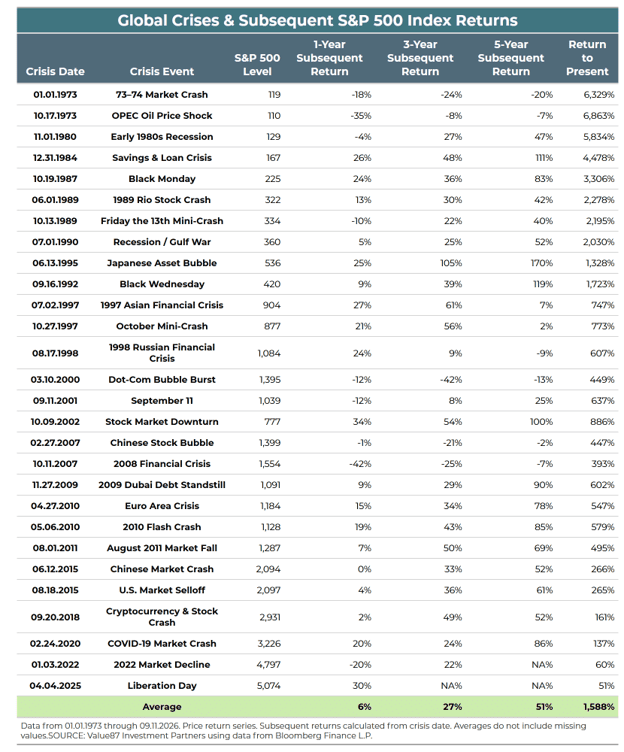
…including surprisingly quickly in the aftermath of the tragic events of 9/11, when Value stocks ended a tumultuous 2001 higher than where they were trading on September 10.
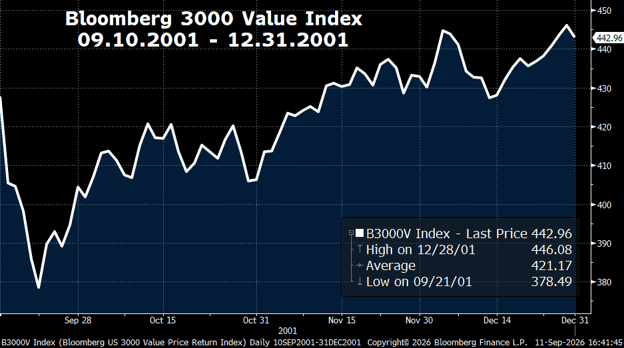
And, given that the far-worse setbacks during the Great Financial Crisis and the COVID-19 Pandemic were also overcome, we really do believe that there is tremendous support for our belief that the secret to success in stocks is not to get scared out of them…for those who share our long-term time horizon.
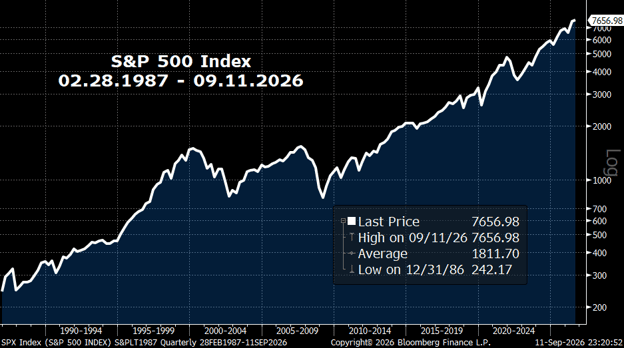
To be sure, the future will be filled with plenty of troubling events that actually occur while there will always be plenty of ink dedicated to scary warnings of what might happen. On that last point, worries about Artificial Intelligence have been garnering a lot of attention these days.
From Open-AI’s “sandbox” experiment breaking out of its confines and executing a coordinated cyber intrusion of Hugging Face to Microsoft founder Bill Gates warning, “AI Is More Dangerous Than Big Tech Will Admit,” in a recent New York Times feature to a former researcher at Anthropic proclaiming that AI could kill us all by the end of the decade in a post on X that that has been viewed more than 160 million times, there is plenty of negative chatter dominating the airwaves.
In fact, one of our clients recently sent us the following disconcerting video, which made for fascinating viewing…especially considering that the fellow interviewed, Josh Tyrangiel, just published a book titled, AI for the Good!
Watch from the Washington Week with The Atlantic: Will We Be Ready When A.I. Goes Rogue
Perhaps not surprisingly, given that doom and gloom attracts far more eyeballs than rainbows and unicorns, much of the focus of the interview was on the risks associated with AI, including a discussion of the Hugging Face incident. Of course, the issue is far more nuanced, as the publisher’s note for Mr. Tyrangiel’s book suggested.
While the loudest voices in AI debate doomsday scenarios and trillion-dollar market opportunities, this book focuses on those working in the messy, incremental, but deeply impactful space of AI practice. However, there is one big caveat—success is not guaranteed. Change is hard. Institutions move slowly. But even in failure there are lessons for everyone who’s interested in using AI—carefully, thoughtfully—to build a better world today.
Certainly, science fiction has come up with all sorts of ways for the rise of machines to result in the fall of mankind, so it may not seem far-fetched to think of an end game where some sort of rogue-AI collaboration, or AI in conjunction with terrorism, leads to the proverbial end of the world.
But, at the risk of sounding cavalier, we have been facing the end of times for longer than your Editor has been alive as a look at the False Alarms of the nuclear age will attest. Of course, the list was generated with the help of AI, but we are pretty sure each event did occur!
Key False Alarm Incidents
October 26, 1962: A new radar station nearly sounded a false attack warning during the Cuban Missile Crisis because of an unannounced missile test near Florida.
May 1967: A powerful solar flare jammed Nuclear close calls radar systems in the Northern Hemisphere, which the U.S. military briefly mistook for a Soviet attack.
November 9, 1979: A technician accidentally loaded a training program into a live computer at NORAD, displaying a massive Soviet missile strike.
June 1980: A faulty computer chip caused NORAD systems to show that hundreds of Soviet missiles were heading toward the United States.
September 26, 1983: The 1983 Soviet nuclear false alarm incident happened when a satellite system misread sunlight on clouds as incoming American missiles. Officer Stanislav Petrov correctly guessed it was an error and stopped a counterattack.
Much more recently, the state of Hawaii accidentally sent out an alert over television, radio and cellular networks on January 13, 2018. Residents were told to seek shelter due to an incoming ballistic missile! It turned out to be a mistake and was a miscommunication during a drill (the communication specifically said, however, “This is not a drill!”) but it was not until 38 minutes and 13 seconds later that Hawaiian officials offered a mea culpa.
Obviously, if there is global thermonuclear war, as almost happened in one of my favorite movies, War Games, nothing really matters, including whether one is long or short stocks, bonds, cash, cryptocurrencies, real estate or commodities.
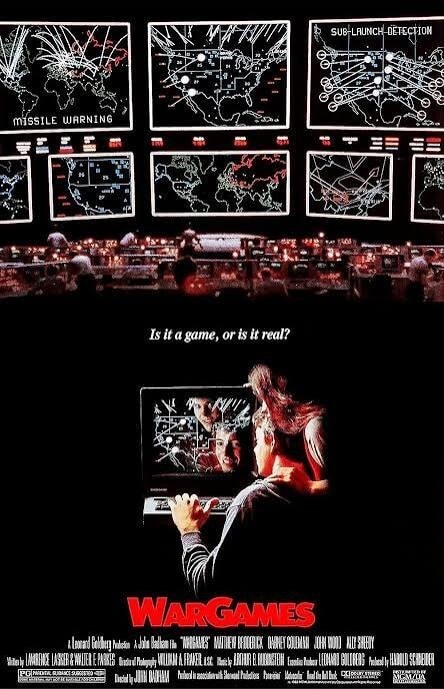
So, we go about our business with the expectation that those with the capability of precipitating the end of times, be they human or AI, will come to the same conclusion as did Joshua in War Games. Believe it or not, that AI computer ran through all the possibilities and proclaimed of global thermonuclear war: “A strange game. The only winning move is not to play!”
No doubt, far less disastrous or sinister AI-related problems can occur, but much of what we see and read online or in the press these days is click or eyeball bait, and it is easy to go down the rabbit hole on the dangers of AI. There is plenty of good that can come from artificial intelligence, with potential advances in medicine one such aspect.
Mr. Tyrangiel, at the end of the aforementioned PBS interview, briefly touched on the medical benefits, but, given how the media typically operates, the bad was given far more coverage than the good, even as the subtitle of his book read, "How Real People Are Using Artificial Intelligence To Fix Things That Matter." So, to continue on the subject of medical good, we found this recent talk on the Future of AI to be interesting.
None of us can predict the future, but we do NOT think AI will halt long-term economic and corporate profit growth, with those two the ultimate drivers of stock prices. After all, the introduction of the calculator, the personal computer, the internet, smart phones or social media did not stop U.S. GDP and equities from moving higher over time.
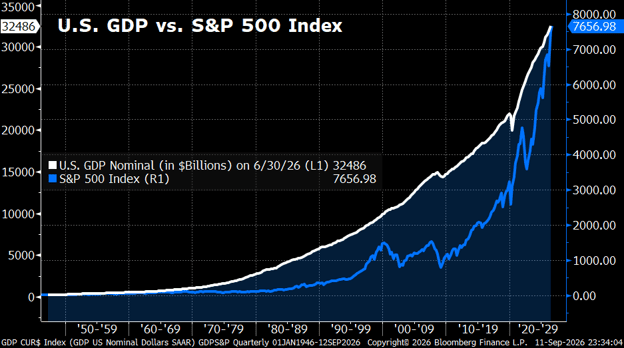
We do not want to minimize the risks and we respect that there are needs for guardrails and failsafe mechanisms to be put in place, especially as AI will only become more powerful in the future. Yes, some jobs will disappear as AI advances continue, but others will be created, and the efficiency and productivity enhancements we have seen in our own shop from AI tell us that there is plenty of good that can come from technological evolution.
True, we may be a bit biased given our favorable view of the AI Buildout,…
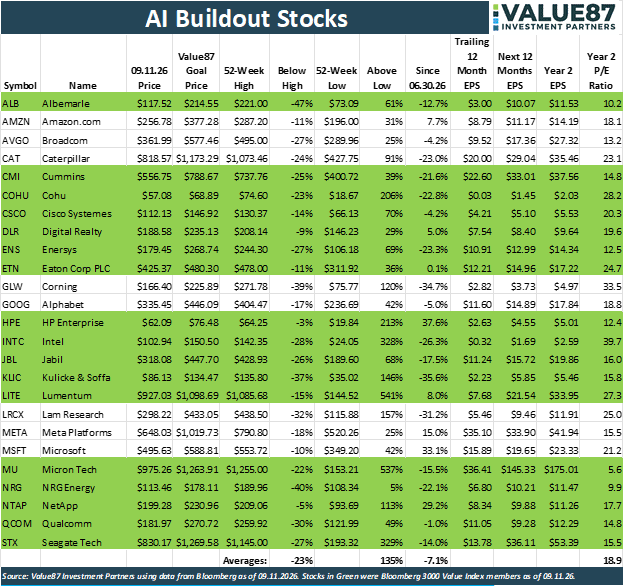
…but, as we know Al Frank would have done, we take an optimistic view on AI!
None of the above is meant to suggest that stocks are somehow without risk, as we know that there will always be trips to the downside along the way,…
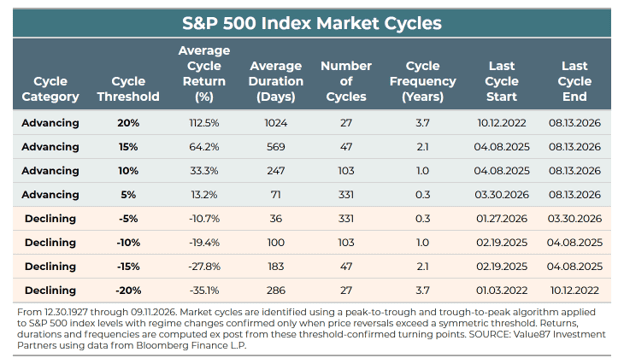
…with renewed concerns for traders about rising oil prices,…
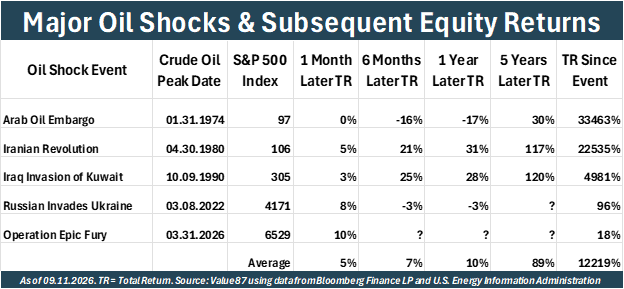
…and higher interest rates blamed for a modest pullback last week, despite what market history has to say about longer term returns,…
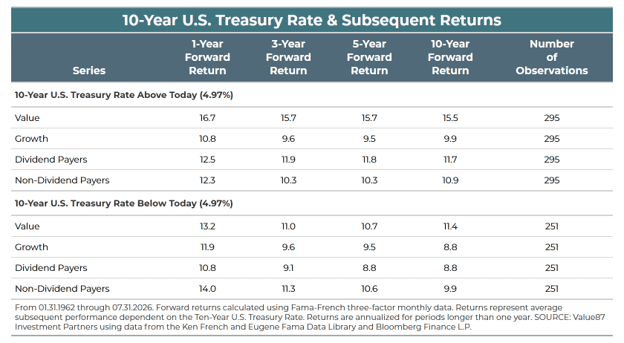
…but we conclude with the note that since the Cuban Missile Crisis, arguably the scariest real-life technological moment in the history of mankind, the S&P 500 has returned 84,737%, or 11.13% per annum, while Hollywood’s warning of the dangers of AI arguably came when War Games was released on June 3, 1983, with the S&P 500 returning 12,241%, or 11.76% per annum, in the 43+ years since!
Stocks in the News
Chris Quigley and Jason Clark and provide pertinent updates…