
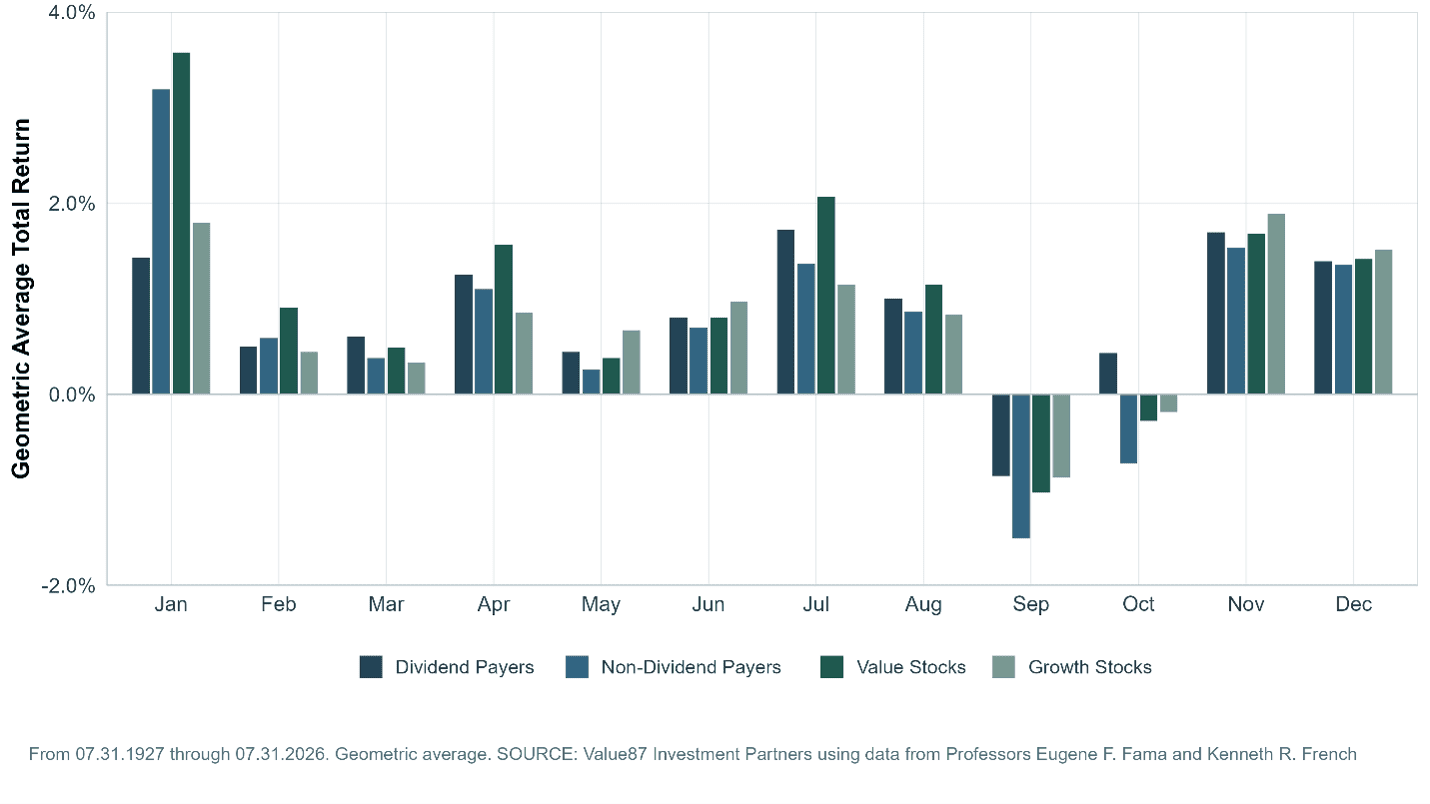
With the Dow Jones Industrial Average falling nearly 900 points (1.65% on a total return basis) and the Bloomberg 3000 Value index retreating 1.46% last week, we were reminded that September historically has been the worst month of the year for stocks,…
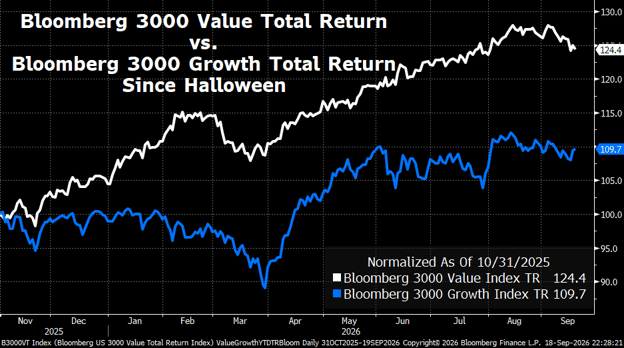
…even as we note that the Bloomberg 3000 Growth index managed a slightly positive return for the 5 days, cutting into the performance lead of more inexpensively priced companies since last Halloween.
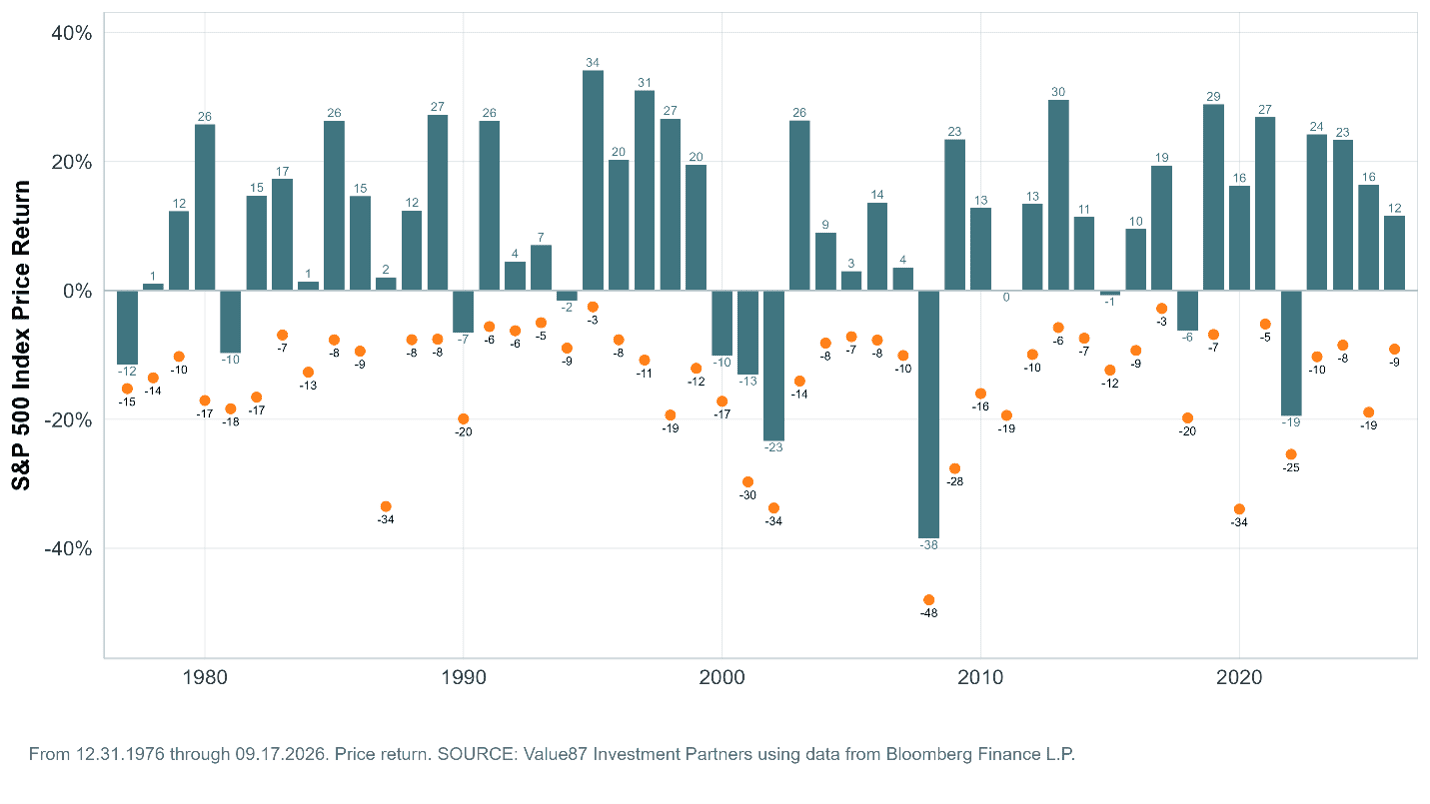
Certainly, we are always braced for downside volatility, as selloffs (the orange dots in the chart below) happen each and every year (happily, the blue bars show there are far more winning years than losing),…
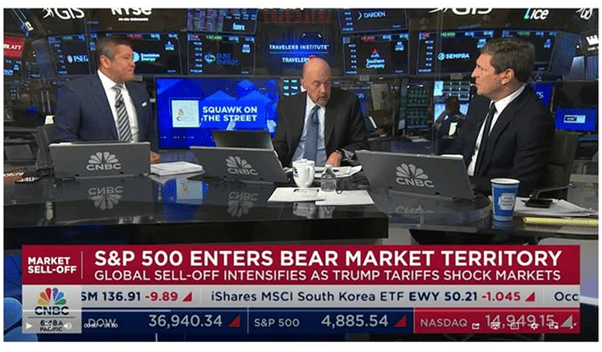
…with 5% pullbacks in the S&P 500 every four months or so, on average,10% corrections taking place once a year and official 20% Bear Markets occurring every 3.7 years,…
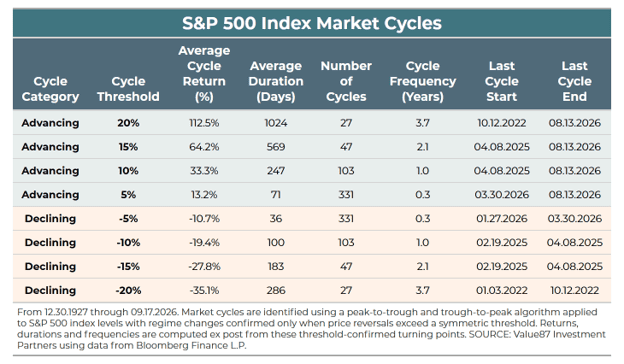
…and an unofficial Bear (it was more than 20% on an intraday basis) hitting just 17 months ago.
Time will tell whether the recent market turbulence is a prelude to one of the many short-term or intermediate-term trips into the red like those detailed in the charts above that investors have endured on the journey to terrific long-term returns,…
…but should stocks move further south in the weeks ahead, the financial press will undoubtedly blame last week’s action from the Federal Reserve. After all, Kevin Warsh & Co. hiked the target for the Fed Funds rate, with the FOMC Statement reading,…
The Federal Open Market Committee approved the following statement for release by a 12 – 0 vote:
The Committee decided to raise the target range for the federal funds rate by 1/4 percentage point to 3-3/4 to 4 percent, in support of the Federal Reserve's dual mandate. The Committee is continuing its policy of maintaining ample reserves in the banking system.
Economic activity is expanding at a solid pace. While uncertainty remains elevated owing, in part, to geopolitical developments, domestic spending has been resilient. Productivity growth is strong, and capital investment is robust. Job gains have kept pace with the workforce, and the unemployment rate has changed little.
Inflation remains elevated. Today's policy action will support a timelier return to the Committee's 2 percent goal. The Committee will deliver price stability.
At his Press Conference that followed the decision on interest rates, Fed Chair Walsh elaborated on the current state of the U.S. economy…
Our decision comes at a time when the American economy appears to be strengthening.
New hiring, private-sector earnings, business capital investment—each of these markers has improved in recent months and is pointing in a good direction. Credit flows have been robust, particularly for businesses. And as I said at the policy symposium in Jackson Hole, I would be hard-pressed to describe broad financial conditions as restrictive. This view was widely shared by the Committee. So we removed a dose of accommodation.
Consider the geopolitical landscape of shocks and uncertainty, and you begin to appreciate the resilience of the U.S. economy. Given that resilience, and the potential for even greater performance, an attitude of optimism is exactly what I heard inside the FOMC these last two days.
One basic sign of strength is the state of America’s labor markets. The jobless rate remains low at around 4.1 percent, and both job openings and weekly hours have been increasing. Unemployment claims, on a four-week moving average, are running at levels consistent with full employment. So, the labor side of the Fed’s congressional remit is in good shape.
That view sounds pretty good to us, especially as economic growth,…
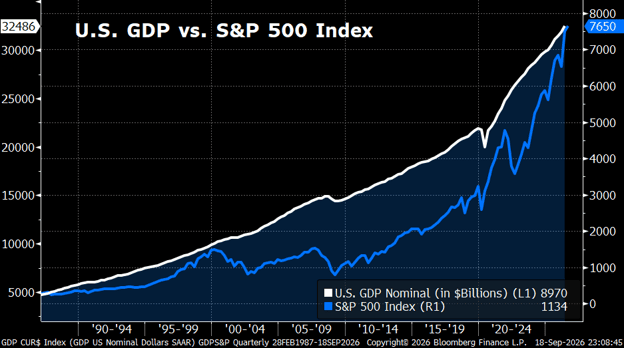
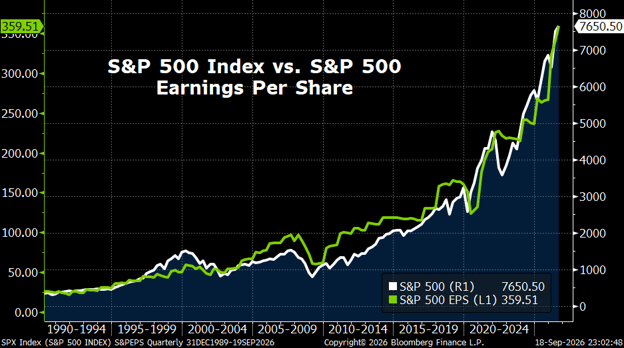
…and profit growth historically have led to higher stock prices over time,…
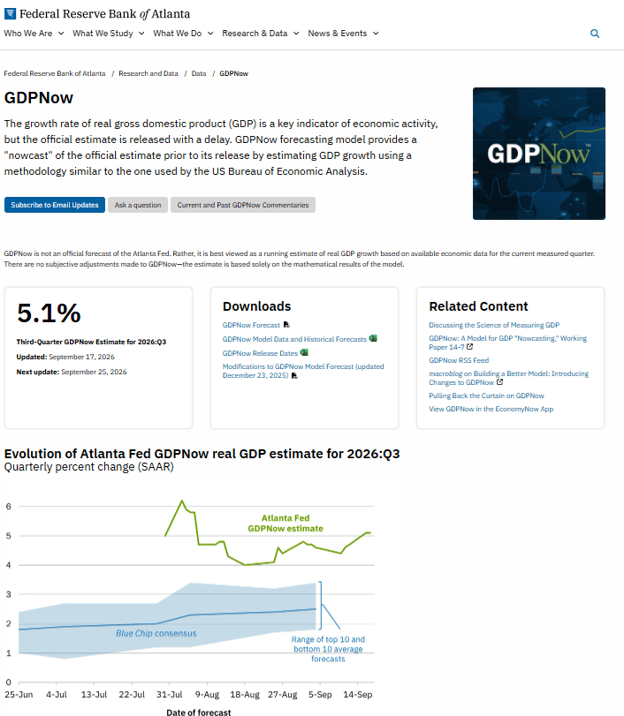
…while the latest estimate for real (inflation-adjusted) Q3 U.S. GDP growth from the Atlanta Fed standing at 5.1%,…
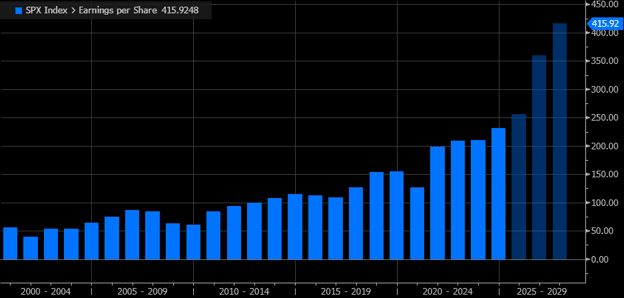
…supports current estimates for continued significant earnings growth for Corporate America.
To be sure, we cannot ignore Mr. Warsh’s Press Conference comments on inflation…
Yet for more than five years, inflation has been running above target. So, our predominant focus is on the price-stability side of our mandate. The plain fact is that inflation is too high and has been for too long.
This summer’s inflation readings do not tell me that underlying trends have meaningfully improved. Based on the most recent CPI and PPI data, the 12-month change in total PCE prices likely was around 3.6 percent in August. Core PCE and CPI prices are running at about 3.2 percent and 2.4 percent respectively. Too many categories are still posting increases above 3 percent, on both a 6- and 12-month basis.
…but seven decades of data show that stocks have enjoyed handsome returns, on average, whether the Core CPI rate is above or below today’s 2.4% rate, and Value actually has performed modestly better, believe it or not, when inflation is high than when it is low.
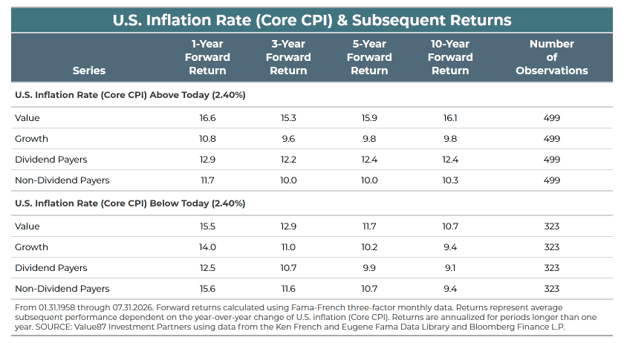
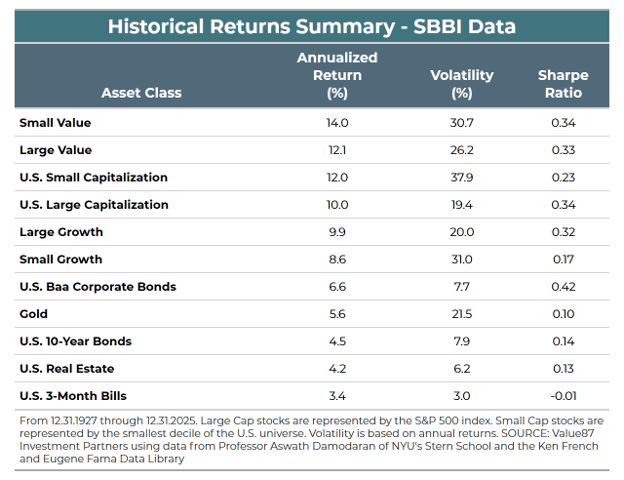
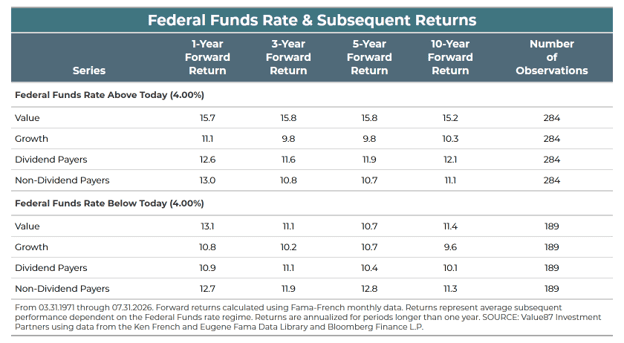
These are simply average return figures, and there have been plenty of negative-return periods in the mix, but we think it important for long-term-oriented investors to consider what has transpired in the past, lest they forget that the secret to success in stocks long has been not to get scared out of them. Certainly, there is no assurance that the past performance will repeat, but there is plenty of evidence to dispel arguments that the Fed Funds rate is high by historical standards,…
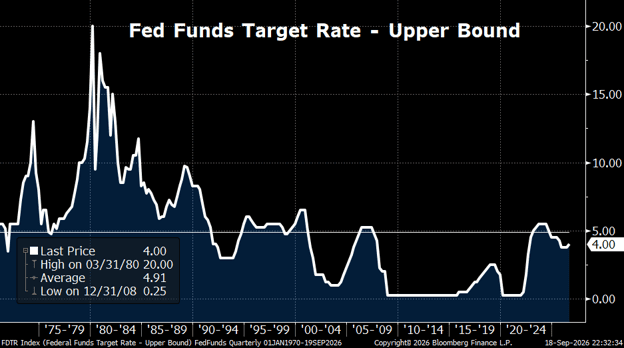
…or that the current 4% upper bound is a headwind for equities,…
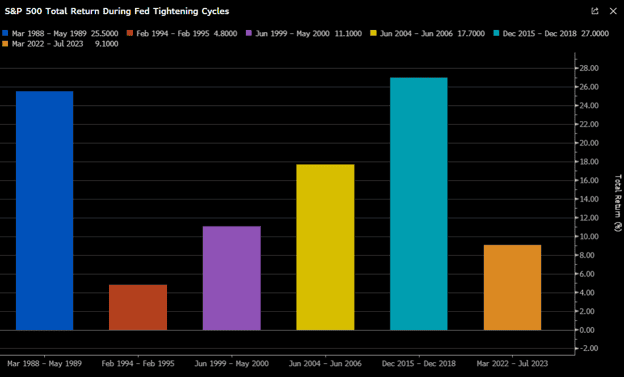
…or that a series of Fed rate hikes, as the Fed Funds futures market is predicting today,…
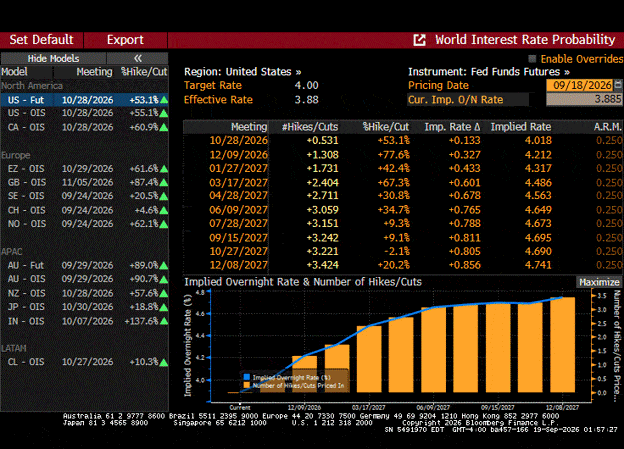
…(a Fed Tightening Cycle) will lead to a decline in stocks.
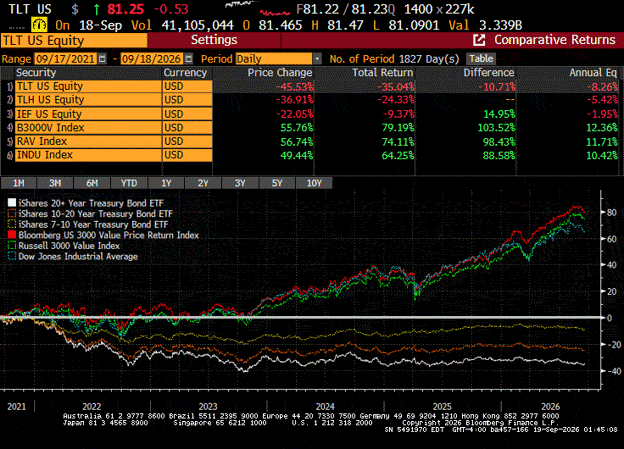
Yes, higher interest rates should make bonds more attractive versus stocks, but the yield on the benchmark 10-Year Treasury soaring over the last five years from less than 1.5% to 5.0%,…
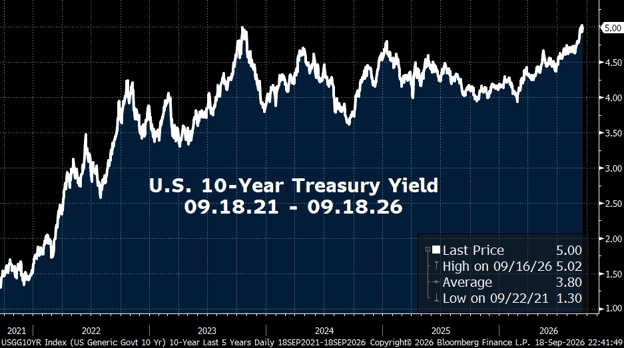
…led to massive losses on long-term government bond ETFs, while equities enjoyed terrific gains.
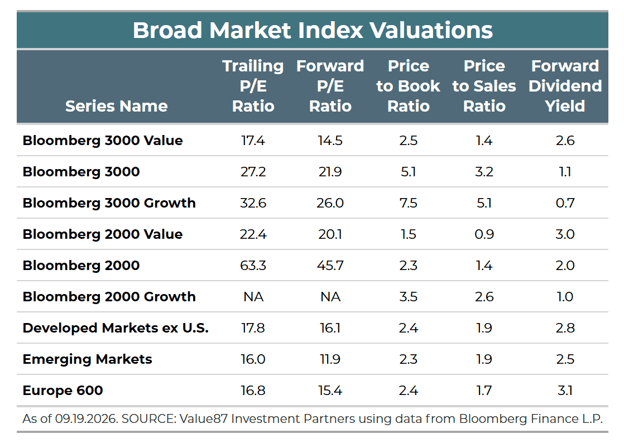
While we realize that returns like those seen in 2023, 2024, 2025 and so far this year have been higher than the historical norm, we retain our optimism for the long-term prospects of equities in general, especially as we think valuations on Value stocks are not overly expensive.
Still, we are well aware that the proverbial herd can hit the sell button with minimal provocation and we note that worries about a slowdown in the proliferation of AI on safety concerns hit many of the companies involved in the buildout last week. The involvement of fickle traders in these names is part of the reason we like our approach of taking some money off the table along the way on our big winners, with such partial sales having occurred several times on some of the stocks, even if P/E ratios a couple of years out for most are still very attractive.
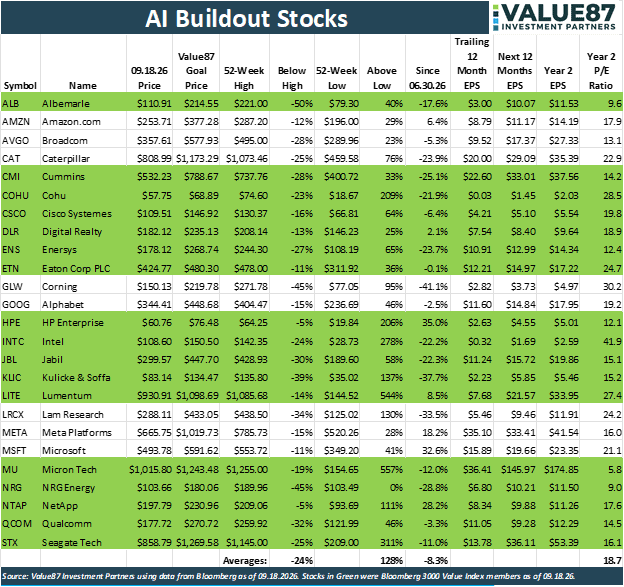
True, the voices have become much louder in the last week or so to put more safegaurds in place on AI and to slow the development of AI models, but tamping the brakes a bit on the meteoric growth could serve to prolong the cycle, reducing the risk that the boom that has driven the buildout stocks to superb advances off of their 52-week lows turns into a bust.
AI safety is front and center these days, and science-fiction has long presented scenarios that could lead to doom for mankind, so it is easy for imaginations to run wild. We hardly think that warnings should be ignored, but as we said last week, since the Cuban Missile Crisis in 1962, arguably the scariest real-life technological moment in the history of mankind, the S&P 500 has returned 85,425%, or 11.14% per annum, so heading to the sidelines has yet to prove the right move for those with a long-term time horizon.
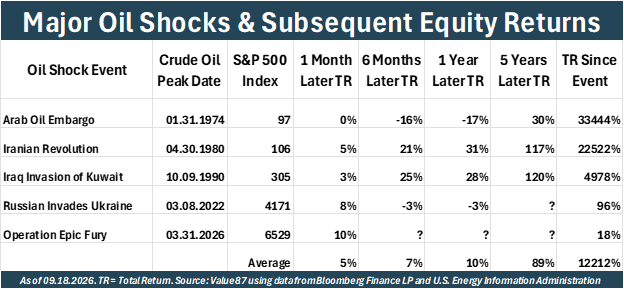
This also goes for other bogeymen that are spooking investors these days, such as spikes in oil prices,…
…or an escalation of the tariff skirmishes,…
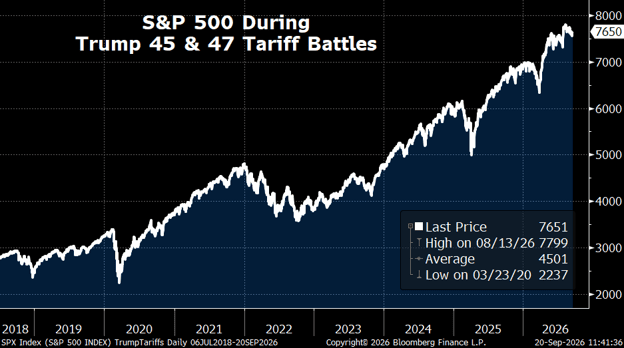
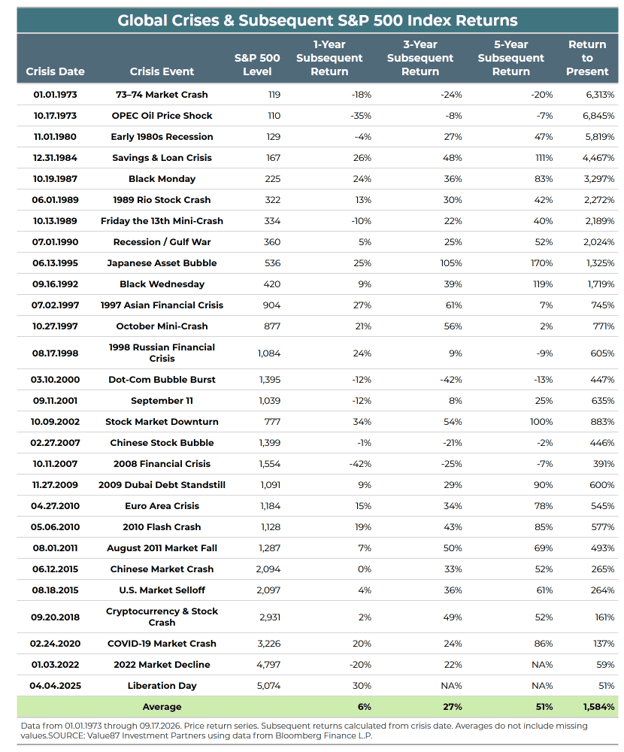
…and we conclude with the reminder that all prior disconcerting events have been overcome in the fullness of time, even if the short run was rocky.
Stocks in the News
Chris Quigley and Jason Clark provide pertinent updates…